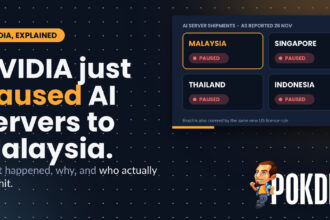


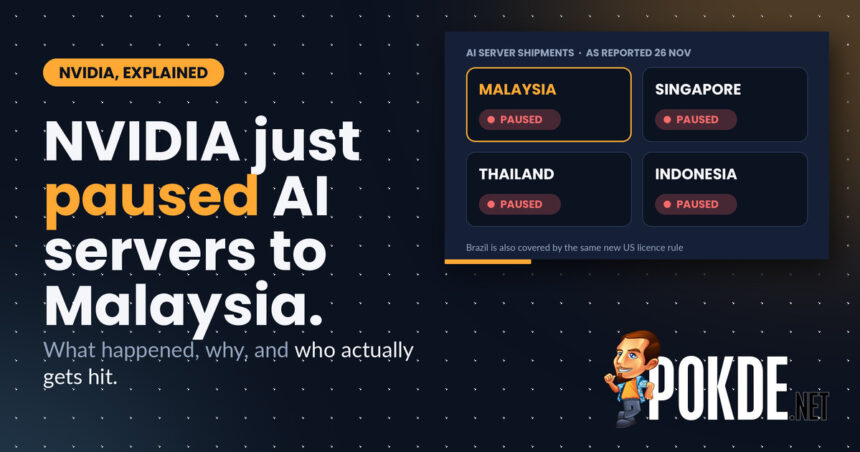
NVIDIA has told its manufacturing partners to stop shipping servers containing its AI chips to buyers in Malaysia, Singapore, Thailand and Indonesia, the Financial Times reported on 26th November 2026, citing three people familiar with the matter. It is the clearest sign yet of how a new US export rule is landing on Southeast Asia’s data centre boom.
What Was Reported

According to the FT, server makers that package NVIDIA’s chips, including Dell and Supermicro, told buyers in the four countries that NVIDIA would not allow their orders to be shipped. It is unclear whether the halt is temporary while NVIDIA and its partners work out how to comply with the new US rules. NVIDIA declined to comment, and as of 27th November it had not issued a statement.
Why Now: A US Rule Barely a Week Old
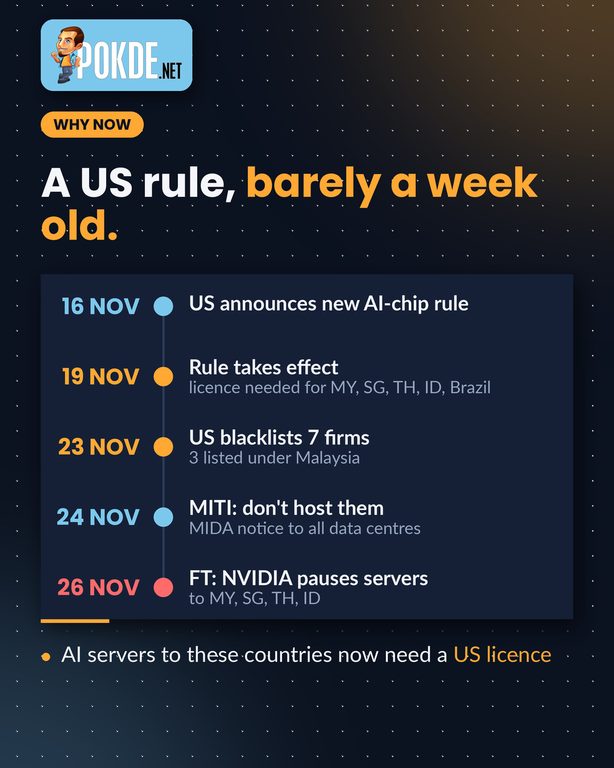
On 16th November, the US Commerce Department’s Bureau of Industry and Security announced an interim final rule called “Addressing Remote Access to Advanced Semiconductors”, which took effect on 19th November. Among other things, it requires a US licence for advanced AI chips and servers shipped to Indonesia, Malaysia, Singapore, Thailand and Brazil, which the US says carry a “higher-than-normal risk of diversion.”
On 23rd November, the US added seven Southeast Asian companies linked to Singapore-based Megaspeed to its Entity List, three of them listed under Malaysia. The next day, the Ministry of Investment, Trade and Industry (MITI) said MIDA would advise all data centre operators in Malaysia not to host, lease space to or provide services to the listed firms, adding that Malaysia “will not allow itself to be used as a channel to circumvent export controls.”
The Loophole: Renting, Not Buying

Direct sales of top-end AI chips to China were already restricted. But Chinese companies could still rent computing power remotely from data centres in other countries that were full of NVIDIA GPUs. The new rule targets that: a licence is now needed whenever a data centre anywhere provides more than 12 million TPP (total processing performance, a US measure of chip compute) to a company headquartered in China or another restricted country. That threshold works out to roughly 750 NVIDIA H100 data-centre GPUs. Data centres already serving customers at that scale have 90 days to get a licence.
Who’s Exempt, and Who Waits
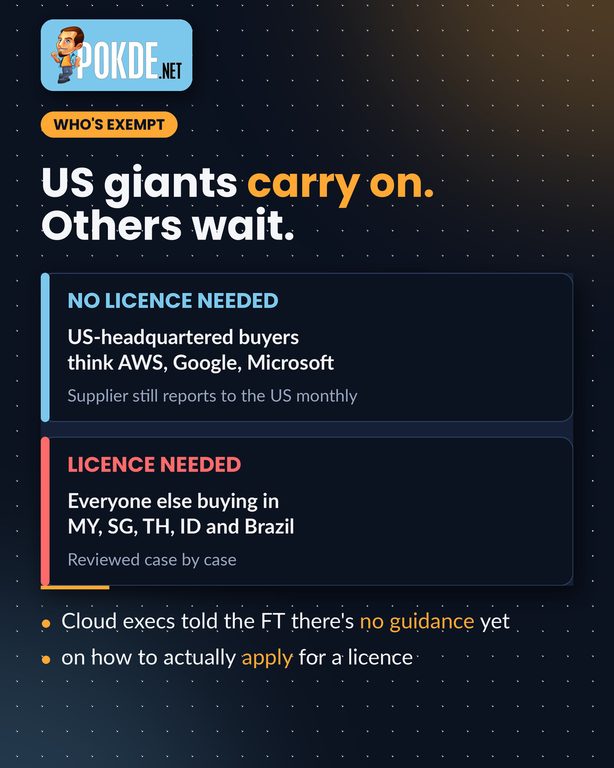
The licence requirement doesn’t apply when the buyer, or its parent company, is headquartered in the United States, though the supplier must file monthly reports. In practice, that means hyperscalers like AWS, Google and Microsoft can keep receiving hardware. Everyone else in the five countries needs a licence, reviewed case by case. The problem, according to a cloud executive who spoke to the FT, is that the rule arrived without guidance on how to actually apply.
Malaysia’s Stakes
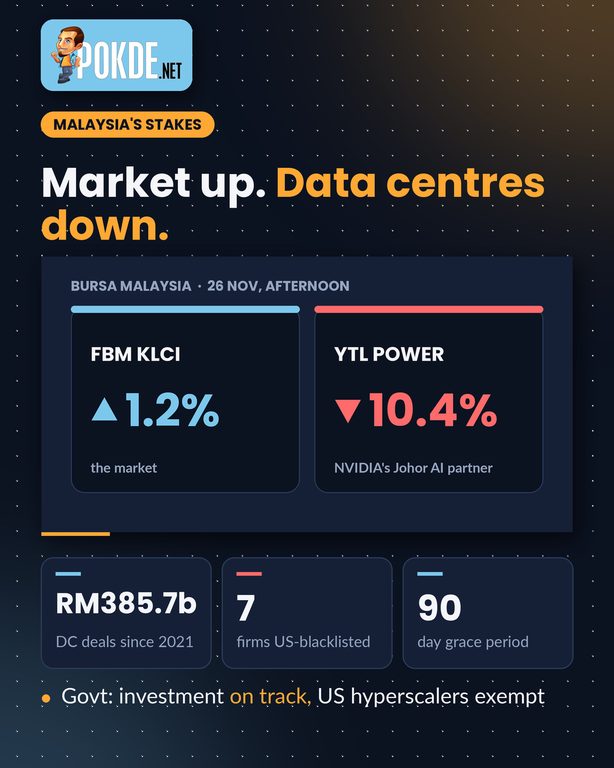
Malaysia has approved RM385.7 billion in data centre-related investments since 2021, according to MITI and MIDA. On the afternoon of 26th November, YTL Power, NVIDIA’s AI cloud partner in Johor, fell 10.4% to RM3.54 while the FBM KLCI rose 1.2%, and other data centre-linked stocks also slid. YTL Power had said on 20th November that its co-location data centres are unaffected by the rule and that reports linking it to chip diversion are “completely untrue.” The government says Malaysia’s AI infrastructure investments remain on track because the major US hyperscalers operating here are exempt.



Don’t Overread the Headline
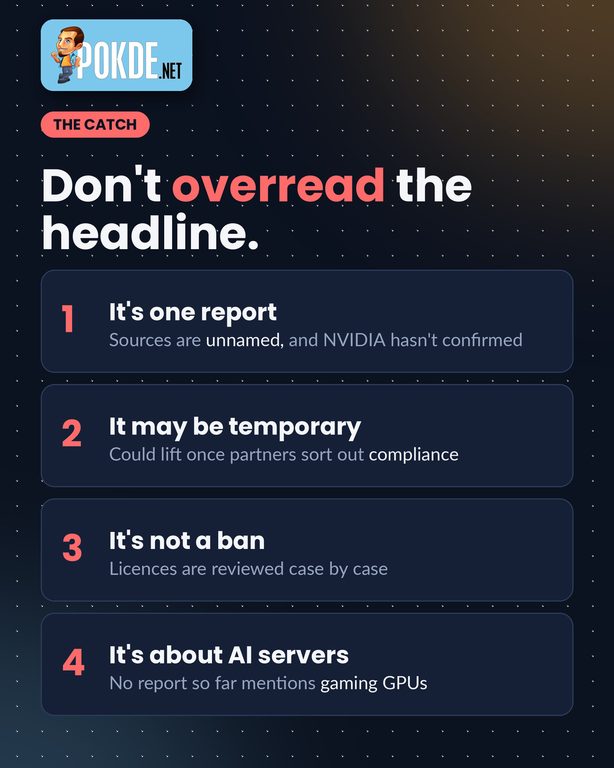
This is one report built on unnamed sources, and NVIDIA hasn’t confirmed it. The pause may lift once partners sort out compliance. The rule isn’t a ban: licences are reviewed case by case, and US-headquartered buyers are exempt. And the reports so far are about data-centre AI servers; none mentions consumer graphics cards.
What to Watch
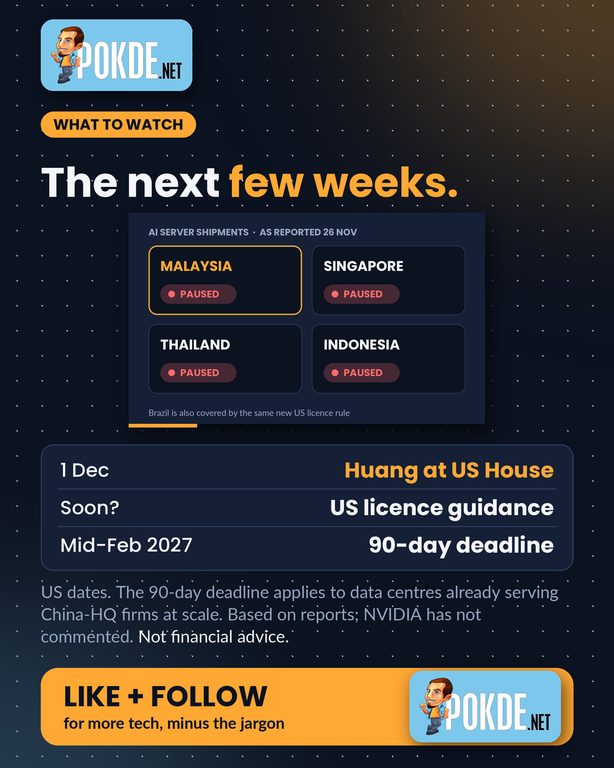
NVIDIA CEO Jensen Huang is scheduled to meet three US House committees on 1 December (US time). Operators are waiting for US guidance on how to apply for licences, and data centres already serving China-headquartered companies at scale face a 90-day deadline that runs to mid-February 2027.
For more interesting breakdowns, stay tuned to Pokde.NET.