


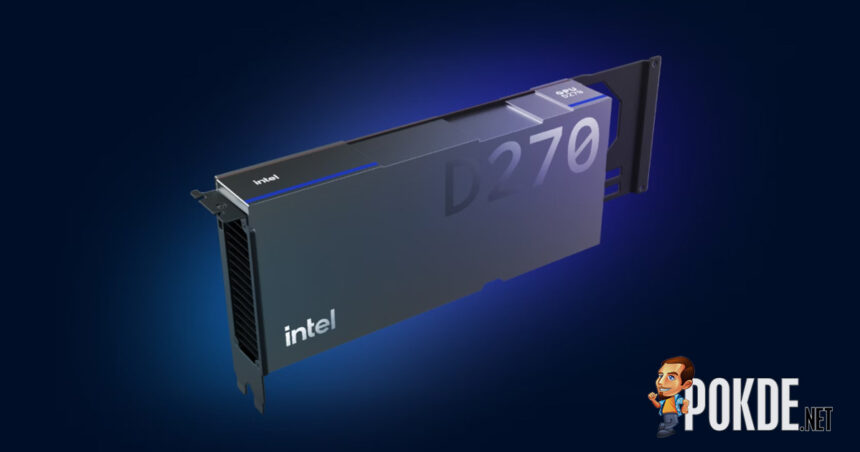
Intel has revealed new hardware and software developments at the Open Compute Project (OCP) Global Summit 2026, including the new Intel GPU D-series, new Xeon-based rack designs, and open software innovations aimed at helping enterprises scale agentic AI workloads more efficiently and cost-effectively.
Intel GPU D-Series (D270)
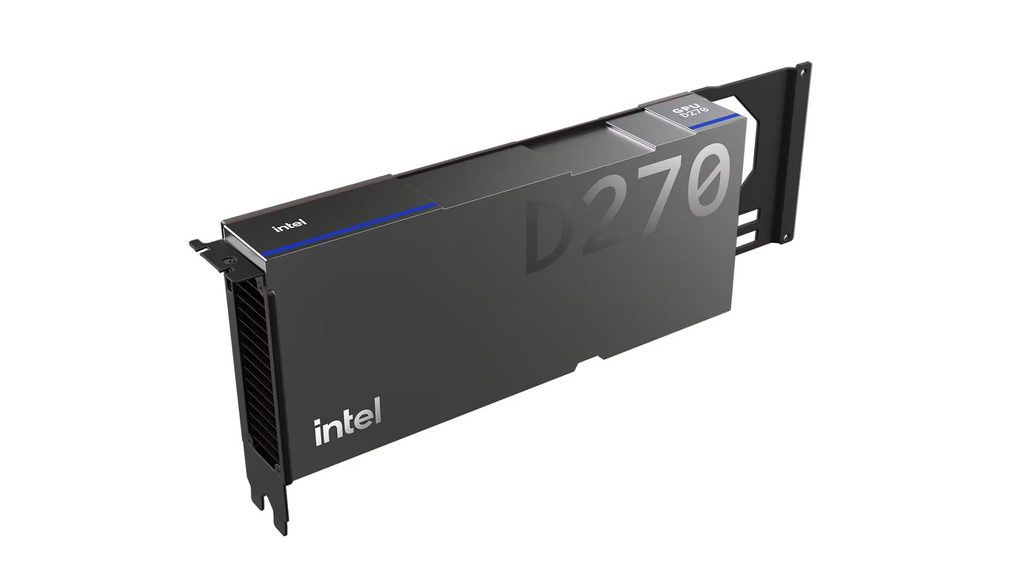
The Intel GPU D-series, formerly codenamed “Crescent Island,” is built on Intel’s Xe3P architecture and is purpose-built for memory-intensive AI inference workloads. The top model, Intel GPU D270, combines up to 480GB of LPDDR5X memory, 1.5TB/s of memory bandwidth, and 1.3 petaflops of FP8 compute, all within a 350W power envelope. The GPU supports large language models with up to 300 billion parameters on a single card and over one trillion parameters in an eight-GPU configuration.
Designed with a standard PCIe form factor and an air-cooled design, the GPU D-series is built to integrate into existing datacenter environments without requiring specialized rack or cooling infrastructure. It shares a common Xe software foundation with other Intel GPU platforms, which should ease deployment. Customer sampling is currently underway, with Intel expanding its hardware, software, and open-source ecosystem in parallel.
New Xeon-Based Rack Designs

Intel also showcased new Xeon-based rack designs developed with ecosystem partners: many of these systems are built on the Open Compute Project’s Open Rack v3 standard, providing modular, deployment-ready infrastructure. Select Xeon 6+ configurations scale beyond 46,000 cores per rack at 133.45kW total rack power, addressing the orchestration and data management demands of complex agentic workflows.
Intel’s open software strategy focuses on native upstream integration with industry-standard AI frameworks, inference runtimes, and deployment environments across both CPUs and GPUs. Key capabilities include software portability across Intel GPU platforms, Day 0 support for emerging open models such as Meta’s Muse Glimmer, and performance libraries designed to optimise inference throughput.
The Intel AI for Enterprise Agent Toolkit, optimised for Xeon processors, provides orchestration capabilities for production agentic applications today. Its provider-based architecture is designed to extend to Intel GPUs, offering enterprises a flexible path to scale across heterogeneous compute resources.
Pokdepinion: Would we see Xe3P in consumer hardware?