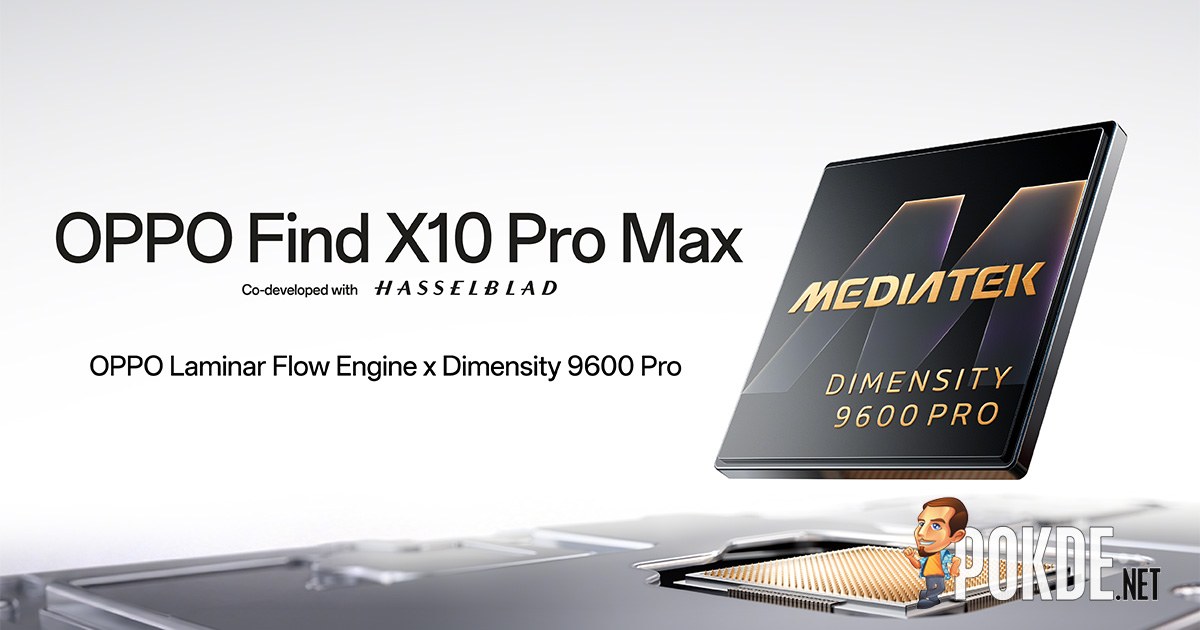


Meet the latest rival of Qualcomm’s Snapdragon 8 Elite Gen 5 – the MediaTek Dimensity 9600 Pro is the first from the Taiwanese company to be built on TSMC’s N2P (2nm) process, leapfrogging the American chipmaker’s current 3nm-based flagship chipset. MediaTek’s new flagship chipset combines a redesigned All-Big-Core CPU architecture, dual-NPU agentic AI engine, new Arm G2-Ultra NX GPU, along with various upgrades destined for upcoming flagship smartphones.
MediaTek Dimensity 9600 Pro: Specs
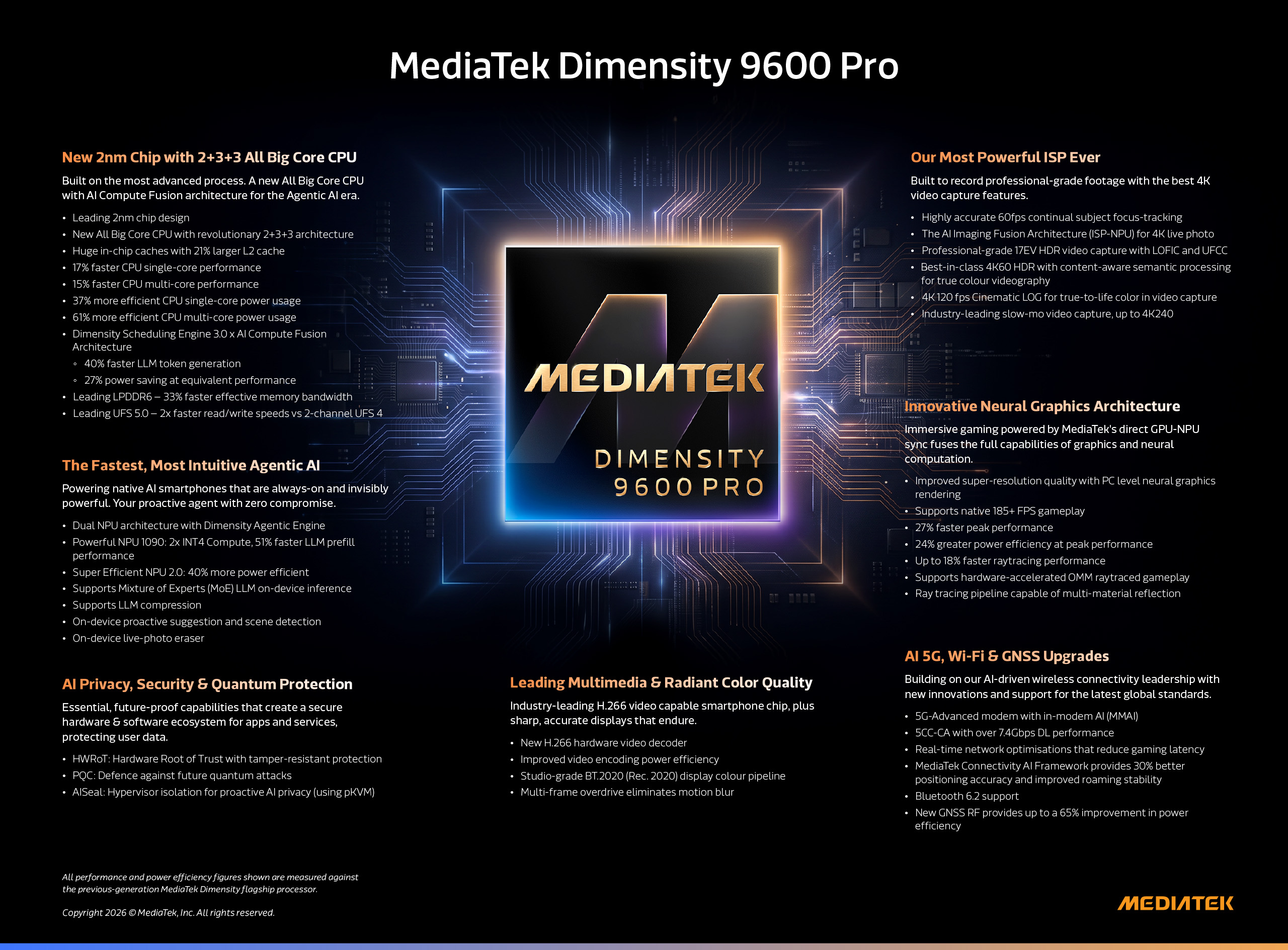
The MediaTek Dimensity 9600 Pro starts with a 2+3+3 All-Big-Core CPU configuration consisting of two Arm C2-Ultra “Prime” cores running at up to 4.55GHz, three Arm C2-Pro “Performance” cores at 4.35GHz, and three further Arm C2-Pro “Efficiency” cores at 3.1GHz. Architecturally, both C2-Ultra and C2-Pro are considered as “big” cores, hence the All-Big-Core claims; compared to the previous generation (Dimensity 9500), MediaTek claims up to 17% higher single-core performance, 15% higher multi-core performance, and a 61% reduction in multi-core power consumption.
On the NPU side, the chip now features a dual-NPU setup – the second-generation Super Efficient NPU cuts power consumption by 40% for always-on AI tasks, while the NPU 1090 delivers 2x INT4 compute power, 51% higher LLM prefill performance and 55% higher token generation per watt. The chip supports on-device inference for models up to 30 billion parameters, enabling capabilities such as proactive assistance, on-device scene detection, and personalized responses.
Supporting this AI architecture is an AI Computing Fusion Architecture that links the CPU and NPU, backed by a massive 34.5MB cache. The Dimensity 9600 Pro also introduces two new standards to the Dimensity lineup: LPDDR6 memory (likely between 10,667MT/s to 12,800MT/s) that is 33% faster than LPDDR5 implementations, along with UFS 5.0 storage that is up to twice the read/write speeds compared to two-channel UFS 4.0 storage.
For gaming, the Arm G2-Ultra NX GPU delivers up to 27% higher peak performance, 24% lower power consumption at peak, and 18% faster ray tracing. The chip supports up to 185FPS gameplay and introduces a Dimensity Neural Graphics Architecture that combines GPU and AI compute for improved super-resolution rendering. MediaTek HyperEngine is also included for additional gameplay optimizations.
Imaging and photography is handled by the Imagiq 1290 ISP paired with the new Dimensity AI Imaging Fusion Architecture, which combines ISP and NPU processing; key imaging capabilities include 4K240 native ultra-slow-motion video, 4K60 AI True Color Tone, 4K120 cinematic log recording, NPU-powered 60fps motion capture, and 17 steps of dynamic range for HDR capture. The chip also introduces hardware decoding for the new H.266 (also known as VVC) video codec.
Connectivity features include a 5G-Advanced modem with in-modem AI, 5CC carrier aggregation with over 7.4Gbps downlink performance, Bluetooth 6.2, and a new GNSS RF front end offering up to 65% improved power efficiency. Security features include hardware root-of-trust, post-quantum cryptography support, and AISeal hypervisor isolation for on-device AI privacy via protected KVM (pKVM).



One More Thing: MediaTek Dimensity 9600M
Alongside the Dimensity 9600 Pro, MediaTek also announced the Dimensity 9600M, a chipset aimed at extending “flagship-level performance and power efficiency” to more users. We suspect this will be the answer to Snapdragon 8 Gen 5 aimed for the upper premium segment, though we haven’t seen a lot of smartphones using Qualcomm’s equivalent thus far, so don’t expect this one to be a common sight either.
The Dimensity 9600M retains the Agentic AI Engine, Dimensity Scheduling Engine, and HyperEngine features, though much isn’t said beyond this point. Its ISP is said to support “real-time AI-enhanced imaging” plus “professional-quality imaging and real-time tracking,” along with “advanced connectivity technologies”.
The first smartphones powered by both the Dimensity 9600 Pro and Dimensity 9600M are expected to launch within the current quarter – OPPO has confirmed it’s upcoming Find X10 Pro Max will be among the first to be powered by MediaTek’s new flagship chipset.
Pokdepinion: 61% lower multi-core power draw is a big claim. Perhaps this could translate to significant improvement in battery life.