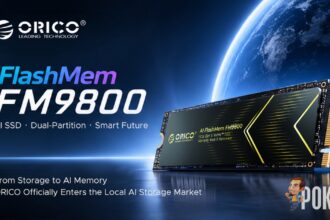

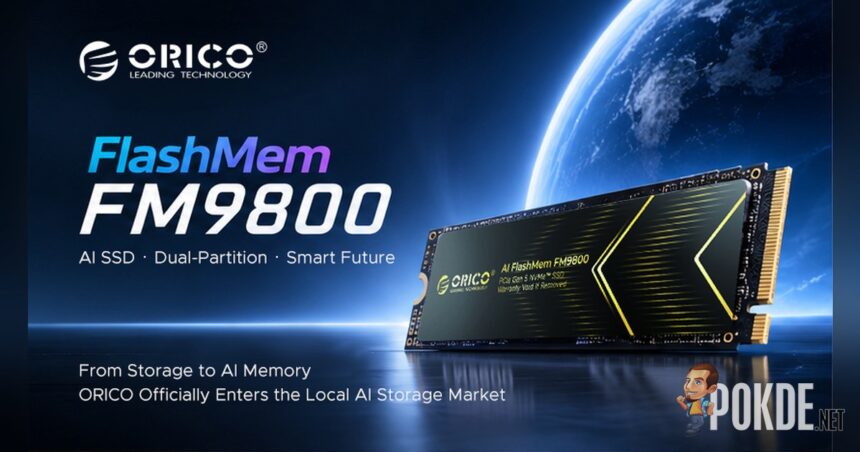
ORICO has announced the FlashMem FM9800 SSD, which is claimed primarily designed to support local AI inference workloads through a dual-partition architecture. Rather than competing purely on conventional read and write speed metrics, this SSD splits a single drive into a general-purpose Storage OS area and a dedicated AI Cache area to further optimize inference performance.
ORICO FlashMem FM9800 SSD
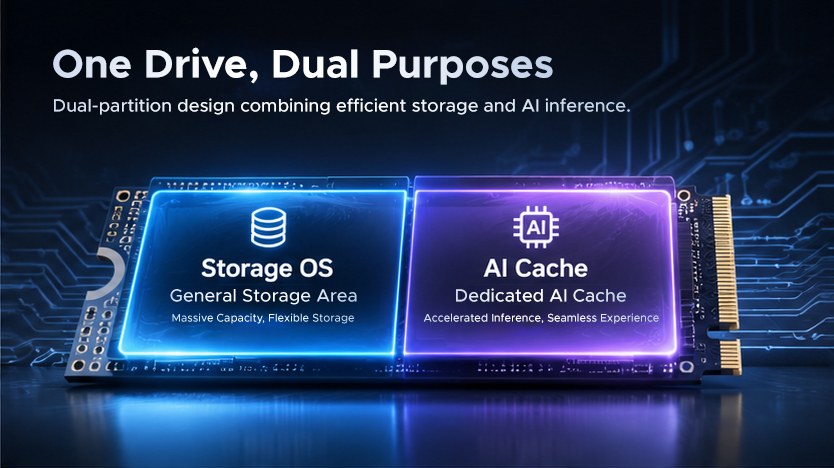
The FM9800 uses the PCIe 5.0 / M.2 2280 form factor and will be available in 1TB and 2TB capacities. The Storage OS partition handles the operating system, applications, and everyday files, while the AI Cache partition is reserved for model weights, context data, and KV Cache generated during inference tasks. Each partition uses separate wear-management strategies and read/write scheduling mechanisms, with a thermal design covering both the controller and NAND components.
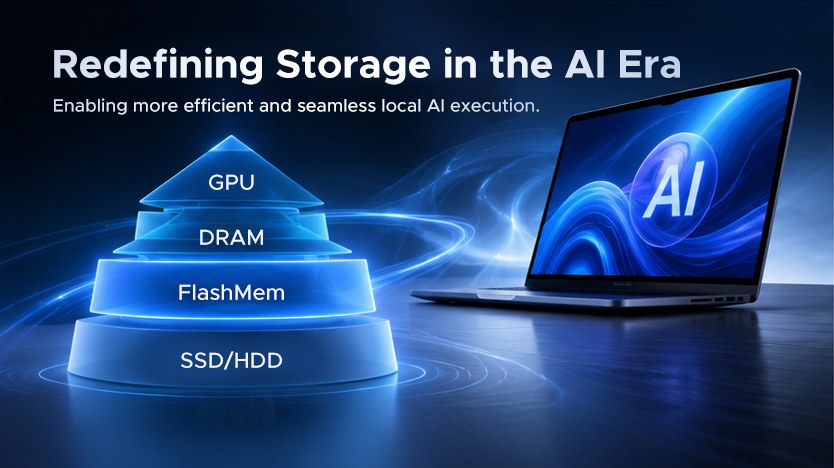
A dedicated partition alone does not make AI caching effective, ORICO says – the FM9800 is designed to work with AI storage middleware and the Herdsman local inference engine, which coordinates data movement across GPU memory, system memory, and the AI flash cache layer. The intent is not for NAND to replace DRAM or GPU memory in terms of speed or access latency, but to hold selected data that does not need to remain resident in high-speed memory at all times (which frees up RAM to work on the AI model itself).
ORICO positions the FM9800 for two broad user groups: the first includes developers and enthusiasts running local large language models on AI PCs or mini PCs with limited memory expansion options, who want to extend available cache capacity for local model execution. The second includes professionals who need to process sensitive documents, such as contracts, R&D files, medical records, source code, and financial data, entirely on-device.
Before deploying the FM9800 for AI workloads, users are advised to confirm that their system has a compatible M.2 PCIe 5.0 slot and that the operating system version, inference engine, and target model are on ORICO’s official support list. For everyday office users, ORICO itself acknowledges that a conventional SSD remains the more straightforward option. The company has indicated that additional AI-related storage devices are in development beyond the FM9800.
Pokdepinion: It’s probably more substance than the so-called “extended RAM” in the smartphone world.