

Product Name: TV A Pro 55 2026
Brand: Xiaomi
Offer price: 1899
Currency: MYR
-
Appearance - 7/107/10
-
Features - 7.5/107.5/10
-
Materials - 7/107/10
-
Performance - 7/107/10
-
User Experience (UX) - 7.5/107.5/10
-
Value - 8/108/10
Summary
The 55-inch Xiaomi TV A Pro 2026 model is by no means an attractive or amazingly-capable TV on its own, but for the price, it just about does the job without too much fuss.
Overall
7.3/10Pros
+ Filmmaker mode & HDR10+ support
+ Near-stock Google TV experience
+ Performance feels decently responsive
Cons
– Batteries not included in remote control
– 120Hz is only available in 1080p resolution
– Subpar speakers, soundbar is a must
Unboxing & Walkaround

As a company, Xiaomi does a little bit of everything. If there’s electronics involved, there’s a good chance they got their hands involved in the business – while we’ve looked at quite a number of smartphones from this brand, this time we’re pivoting to home electronics, and specifically the 2026 model year Xiaomi TV A Pro is the subject of our review today.

The accessories you get along with the Xiaomi TV A Pro 2026 is quite minimal: a pair of plastic-made TV stand along with four long black screws, two power cables (Type G or Europlug – either one works on our sockets), and the remote control, which intriguingly lacks a pair of AAA batteries onboard. We can’t say if this is specific to our review unit, but you can bring your own if you get one of these, just in case.
(Additionally, we also found 4 shorter screws that are undocumented, which we cannot find anywhere on the TV in which these screws will be utilized. They’re certainly not the kind for wall mounting uses.)


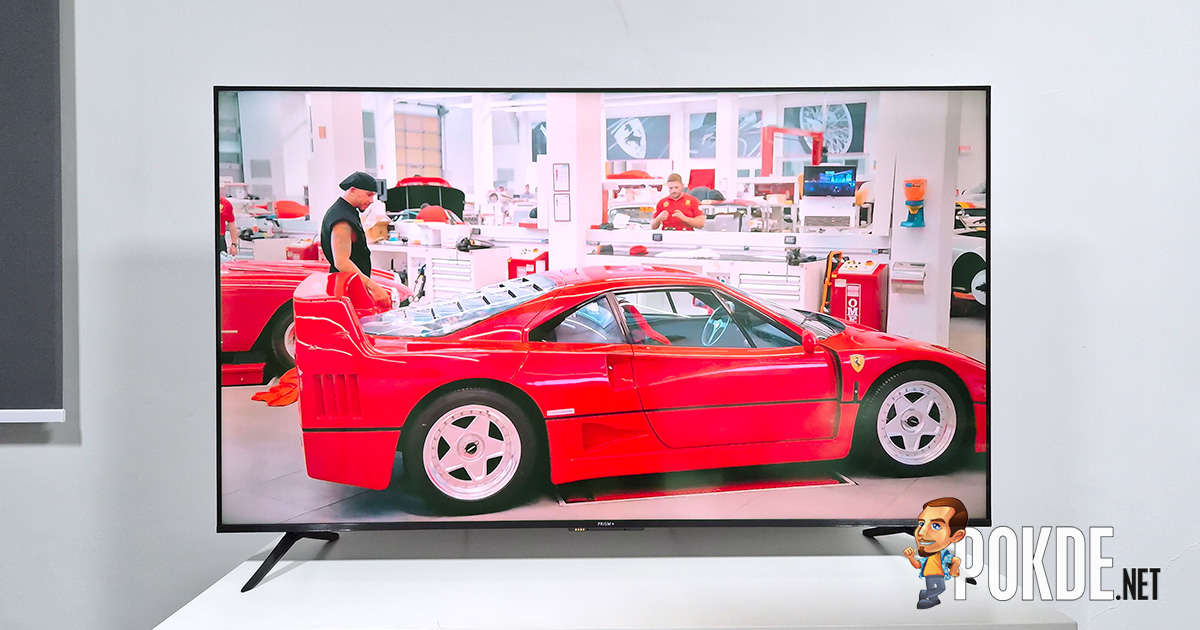
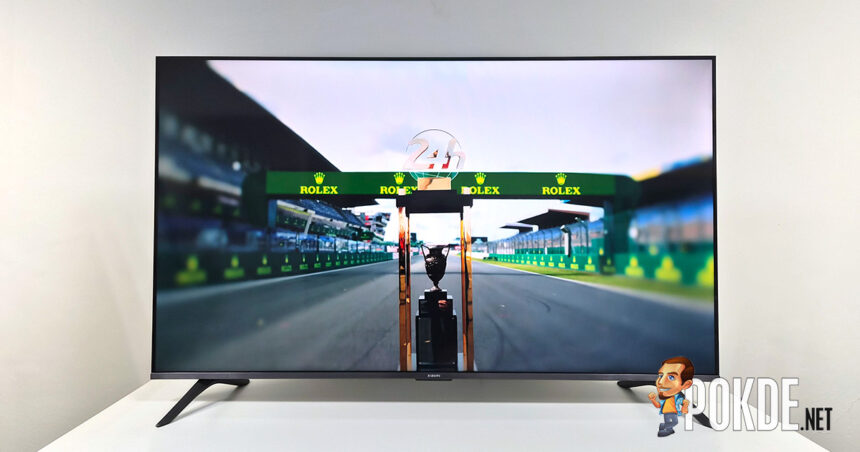
At the front, the Xiaomi TV A Pro features a QLED panel to emit 8.3 million pixels that is 4K resolution, and in our case it’s a 55-inch panel. (There are variants as small as 32-inch and as big as 75-inch.) Note the reflection on the display, which indicates that this is a semi-glossy panel that has good black levels while keeping glare reasonably in check. The I/O is located at the center bulge facing left (right if viewed from the rear), and you can also find the 300 x 200mm wall mounting sockets here as well.


The 2-pin AC connector is separated from the rest of the I/O, and among them, they include S/PDIF optical audio, 3.5mm audio jack, three HDMI ports (HDMI 2 supports eARC and ALLM), a USB 2.0 port, RJ-45 LAN port for internet, and the coaxial connector for TV tuners.


The Xiaomi TV A Pro 2026 adopts two-piece stand design, and they’re constructed from plastic; while sufficient in keeping the TV upright, we do think it feels a bit flimsy given how lightweight the stands are. Granted, this is like the car door situation (where manufacturers intentionally make doors sound “heavy” despite being lightweight), and we should make it clear it’s not necessarily an immediate quality issue. Down in the middle is where the sensors and LED indicator lies, which blinks as you turn on the TV and stays out of the way otherwise.
Specifications
Xiaomi TV A Pro 2026 (55-inch)
Full specifications available on product webpage.

| Size | 55-inch |
| Display Panel Type | QLED (Quantum Dot LED) |
| Resolution | 3840 x 2160 |
| Refresh Rate | 60Hz *120Hz available in HDMI 1080p via Game Boost Mode |
| Pixel Response Time | Unspecified |
| Gamut Coverage | 94% DCI-P3 |
| Color Depth | 10-bit via 8-bit + FRC (1.07B colors) |
| HDR Support | HDR10+ Hybrid Log-Gamma (HLG) |
| Brightness | Unspecified |
| Contrast Ratio | Unspecified |
| Variable Refresh Rate Support | None |
| Display Certifications | None |
| Processing Hardware | Arm Cortex-A55 quad-core CPU Arm Mali-G52 MC1 GPU 2GB RAM, 8GB onboard storage |
| Operating System | Google TV (Android 14) |
| I/O | 1x AC-in 1x S/PDIF (TOSLINK) out 1x 3.5mm audio jack 3x HDMI (eARC + ALLM on HDMI 2) 1x USB 2.0 1x RJ-45 LAN 1x Coaxial |
| Connectivity | Wi-Fi dual-band (2.4 GHz + 5 GHz) Bluetooth 5.0 Miracast, Google Cast, Apple AirPlay |
| Onboard Speakers | 2x 10W stereo Dolby Audio, DTS:X |
| Power Consumption | 130W typical, <0.5W standby power |
| VESA Mounting | 200 x 300 mm |
| Stand Type | Two-piece stand, plastic |
| Dimensions & Weight | TV only: 1226 x 76 x 711mm, 9.1kg TV with stand: 1226 x 312 x 770mm, 9.2kg |
User Experience

The first thing you pick up right after getting the Xiaomi TV A Pro 2026 in place is the remote control, and I’m pleased to report that it’s not the over-minimalist kind that you’ll find in brands like Samsung – bonus points for being intuitive. Volume and channel switch get their own dedicated keys, and there’s a full T9 keypad layout for keying the specific channel number; the ring-shaped bit in the middle mostly serves as directional keys, though in some cases – like watching Xiaomi’s free TV service – the up and down buttons also function as channel switching buttons.

One somewhat positive thing to say about the Xiaomi TV A Pro 2026 is the software, or more so the lack of additional software processing. Granted, motion boosting are enabled by default and the TV doesn’t really make it clear right away unless you dig deep into the TV settings, but aside from that, there’s not much manual intervention required to make it display content just as intended.


During our testing, we’re surprised to find out that Xiaomi even includes a dedicated picture mode for PCs, and what it does is essentially improve the UI / text clarity that TVs often overdo with excessive oversharpening (and sometimes unnecessary overscan aspect ratios) in place. If you ever need the TV to function as a monitor, it does that pretty well too; upon closer inspection, we found the QLED panel uses striped Blue-Red-Green subpixel layout (as seen above), which produces no fringing issues.

If you ever needs to adjust color temperature, you’re given five presets, though finer tuning is available via Custom which gives you Red, Green and Blue values in 10-bit depth (1024 levels). Do note that according to Xiaomi’s spec sheet, the TV’s 10-bit implementation involves 8-bit + FRC, which replicates 10-bit color but is not the true 10-bit color that is used by content professionals.

In terms of backlight brightness, we measures up to 383 nits in the center of the screen where it is the brightest (with backlight setting adjusted to 100% beforehand), though the values drop quite aggressively in edge portions going as low as ~250 nits in some grid sections. In practice, you might notice a small amount of uneven brightness across the panel (note that brightness value scales exponentially to human eyes); the panel can still handle relatively bright environments, though anywhere close to a natural light source might be an issue, so plan your installation accordingly.
The Good

TVs generally don’t get big upgrades these days, so the Xiaomi TV A Pro 2026 is expectedly a small improvement over the last year’s equivalent. The upgrades include new Filmmaker mode – which minimizes post-processing and displays content as closely as intended – along with HDR10+ support that widens this QLED panel’s capabilities. Granted, it’s not the kind of top-notch quality you’ll find in much more expensive models out there, though it does the job fine if you aren’t particularly picky.
The Google TV part of the experience is decent, too. For what it’s worth, the combination of quad-core Arm Cortex-A55 processor and the underlying near-stock Android 14 operating system amounts to a decently smooth performance that is fairly easy to navigate, and the latency of its remote control is certainly solid – I’m pretty sensitive to laggy control inputs of many kind, and I find no issues on this TV during the review process.
The Bad

While the remote control itself is solid to use, it seemed like batteries do not come included if you buy the Xiaomi TV A Pro TVs. While not necessarily deal-breaking, it’s a slight inconvenience that can perhaps be avoided given that most other accessories people buy – think computer mice, keyboards, and the likes – do come with batteries included, so it’d be nice to have them included next time just to save a couple of minutes for new TV owners.
While QLED technology sounds pretty advanced on paper, Xiaomi’s implementation certainly points to a budget-focused approach. The 4K panel, while technically capable of 120Hz refresh rate, only operates in very specific conditions: in 1080p resolution, through Game Boost mode, and requires HDMI 2 input. Let’s just say current-gen console like PS5 or Xbox Series X won’t be able to properly stretch their proverbial legs given this limitation.
Another downside of this TV is, expectedly, the speakers. The dual 10W unit can produce loud volume, though bass is pretty much non-existent no matter how far you push the equalizer up on the low-frequency bands. If you want proper sound quality out of this, make sure you get a sound bar.
Verdict

Currently, Xiaomi’s official pricing for its TV A Pro 2026 lands on RM1,899, though this may change as time progresses; for that kind of price, having 55 inches of screen area is pretty decent value all things considered. That being said, it’s not going to offer you much beyond what a basic smart TV is capable of, so keep your expectations in line when you decided to buy one of these models.

Special thanks to Xiaomi Malaysia for providing the Xiaomi TV A Pro 2026 (55-inch) for this review.