
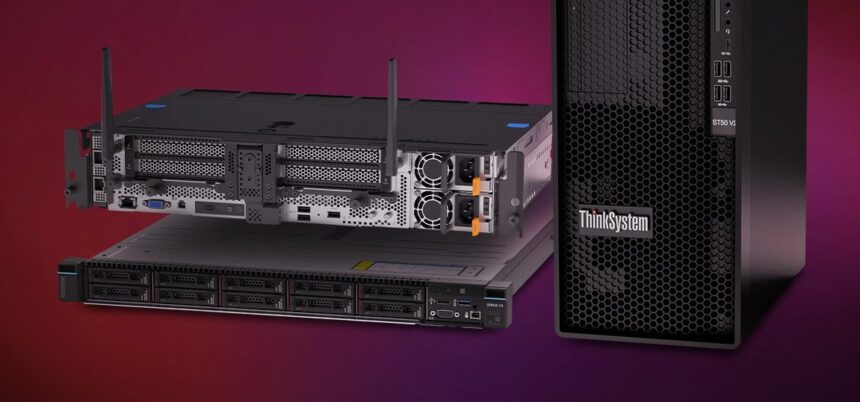
Lenovo has announced new servers, storage arrays and services aimed at artificial intelligence (AI) and high-performance computing (HPC) workloads. The lineup includes Lenovo ThinkSystem servers powered by 6th Gen AMD EPYC 9006 SP7 processors, new storage and interconnect options, Neptune liquid cooling, and expanded Hybrid AI services for enterprise and gigawatt-scale AI factories.
The portfolio is meant for organizations running AI and HPC workloads in their own data centers, in hybrid environments and in colocation facilities. Lenovo says demand for this kind of infrastructure is rising as continuous inference, agentic AI and more complex scientific workloads become more common.
New Lenovo ThinkSystem Servers and Storage Arrays
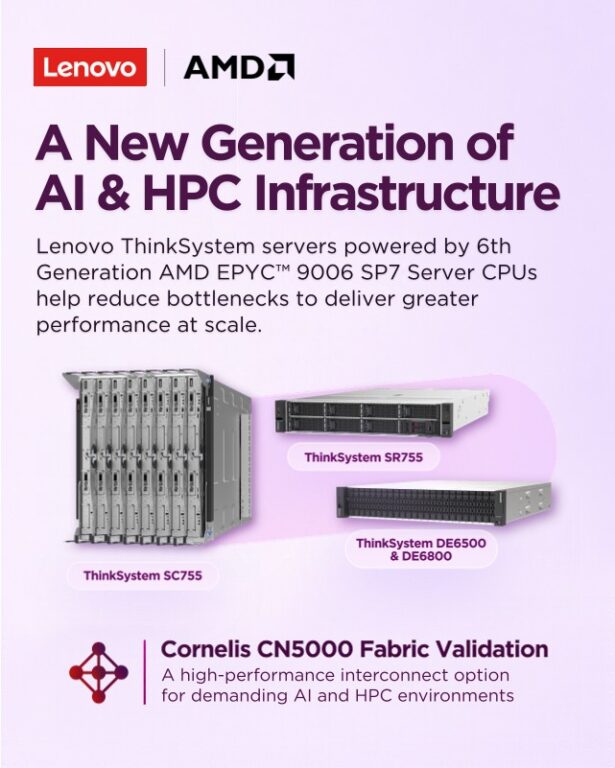
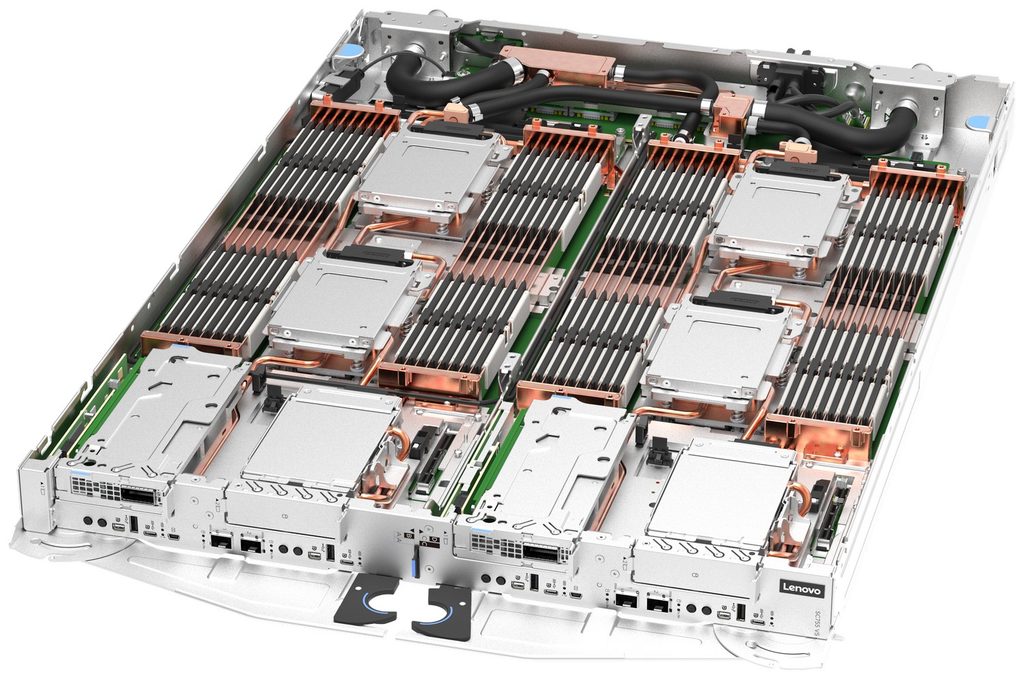
The ThinkSystem SC755 is a dual-socket server with Neptune liquid cooling. Lenovo claims it can remove up to 100% of system heat via water and deliver up to 40% higher sustained performance than comparable air-cooled systems. It also supports Lenovo Dynamic Partitioning, which lets customers convert two dual-socket systems into single-socket systems and back again.
The ThinkSystem SR755 is aimed at large-scale virtualization, engineering, financial modeling, electronic design automation (EDA) and agentic AI infrastructure. It is built for high compute density and memory bandwidth. Lenovo says it uses less power and costs less to run than dual-socket configurations.
On the storage side, the ThinkSystem DE6800 and DE6500 are designed for high-throughput, latency-sensitive block workloads. The DE6800 targets high-throughput applications that need reliable storage. The DE6500 is the lower-cost option, with simpler deployment and management. Lenovo has also validated the Cornelis CN5000 fabric as an interconnect option for AI and HPC environments.
Hybrid AI Factory, Gigafactory and Colocation Services
Lenovo’s Hybrid AI Factory Services now include GPU deployment, configuration and optimization. The services also add multi-node support across Red Hat AI Enterprise and NVIDIA AI Enterprise with NVIDIA Run:ai. This lets customers choose the operating environment for workloads such as agentic AI and physical AI.
For larger deployments, Lenovo is adding gigafactory services that include NVIDIA Infrastructure Services (NVIS) expertise for specialized deployment and cluster validation. The services cover every stage of a project, from concept and build through deployment and optimization for production.



Lenovo can also arrange access to Digital Realty’s global network of colocation facilities for organizations that need more data center capacity. Customers can use the Digital Realty Innovation Lab (DRIL) to validate AI infrastructure, applications and workload requirements. Lenovo acts as the single point of contact, and financing is available through Lenovo TruScale Infrastructure as a Service.
Existing Customer Deployments
Lenovo pointed to existing deployments, including sovereign AI research in Bavaria, Germany, and fusion energy simulations at Imperial College London. At the University of Florida, the fourth-generation HiPerGator system (built on Lenovo, NVIDIA and AMD hardware) delivers 17.49 PFLOPS. It processed 33 million research requests over the past year.
DreamWorks Animation uses Lenovo Neptune liquid-cooled servers in its data center. According to Lenovo, this gave the studio 20% higher performance and faster rendering.
Lenovo has not disclosed pricing or availability for the new servers, storage arrays or services. The company is showing the portfolio at SC26 (Booth #3023), and more details are on its HPC solutions website.
Pokdepinion: Liquid cooling in HPC isn’t news anymore, but the Digital Realty colocation tie-up is the more interesting bit here.