

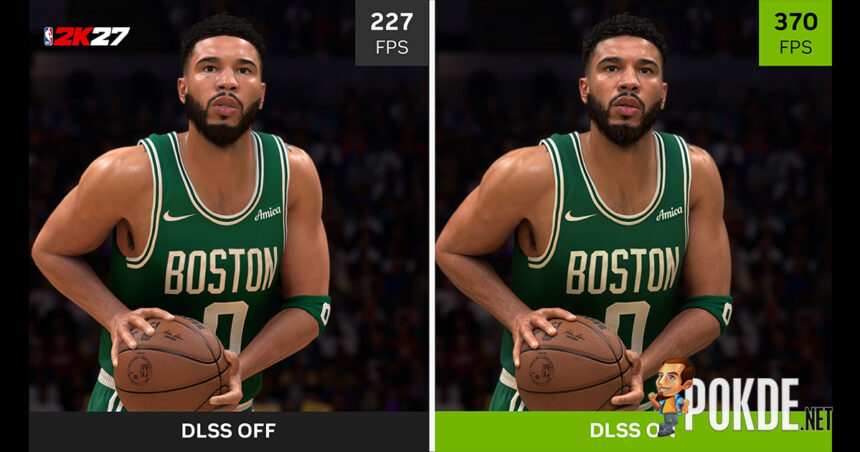
NVIDIA’s controversial DLSS 5 feature is coming very soon – NBA 2K27, launching 3 Sept 2026 at 9AM PT (4 Sept 12PM MYT), will be the first title to feature this new AI-powered graphics enhancement technology that is available only on GeForce RTX 50 series GPUs (both desktop and laptop variants), as well as RTX 5080-operated GeForce NOW Ultimate tier subscribers.
Unlike previous iterations of DLSS technologies, DLSS 5 is not about performance, but rather “Hollywood-grade photorealism.” NVIDIA says it uses AI to generate lighting and material detail that real-time rendering constraints have traditionally forced developers to simplify or remove, claiming that it can “bridge the cinematic gap.” Under the hood is what NVIDIA calls “3D-Guided Neural Rendering”, meaning the AI relies on the in-game scene rather than text prompts to produce the result.
DLSS 5’s 3D-Guided Neural Rendering Aims For Cinematic Graphics


DLSS 5 works by generating lighting and material detail directly, using the game engine’s rendered frame (including its geometry, textures and lighting buffers) as the base input. The company said this approach was necessary because standard generative models are probabilistic and produce inconsistent results between runs, which is not viable for games that require stable character identity and frame-to-frame consistency.
To address this, NVIDIA built a new AI model (a generic model that is not game-specific) designed to operate deterministically, using engine data such as color, surface albedo, lighting and surface normals to maintain consistency with the original frame. The model also operates on a strict “one-frame-in, one-frame-out” basis, using motion vectors from the game engine to avoid shimmering or temporal drift as players move.
The company added that the model is compact enough to run on a single GeForce RTX 50 series GPU at up to 4K resolution with “smooth frame rates”. If you want to see the results for yourself, click this, this one, and this text.


Developers can integrate DLSS 5 through the existing NVIDIA Streamline framework or an Unreal Engine 5 plugin, and can enable it independently alongside Super Resolution, Multi Frame Generation and Ray Reconstruction. The technology includes controls such as Structure Intensity (for detail like ambient occlusion and reflections) and Tone Intensity (for broader lighting and color response), along with semantic AI masking that lets developers apply enhancements selectively to specific objects, characters or props.
In NBA 2K27’s case, DLSS 5 is applicable to player skin, hair and lighting detail while preserving facial geometry scanned from real athletes. Developer Visual Concepts said the tool improved subsurface scattering, contact shadows and light transmission through hair for players such as Cade Cunningham and Tyrese Haliburton, as well as for courtside spectators and staff models. Once enabling “DLSS Neural Rendering” in the in-game settings, the feature can be toggled during gameplay and replays using the F9 key.



While NVIDIA is pretty adamant that DLSS 5 is not just a filter, community reactions during DLSS 5’s initial reveal was generally negative. Between cases of “AI slop filter” and “yassified” Grace, the result is often a hit-or-miss, which brought up a debate of whether this technology can stay true to developer’s artistic vision. To that end, the company stresses that developers are in full control on how involved this tech can be.

There’s also the performance aspects – having the AI to handle all the lighting conversions meant that performance cost is massive. We guesstimated the native DLSS 5 performance by decoding the AI-enhanced framerates in the chart (in this case with MFG 6x applied and SR Quality preset, i.e. 720p input), and the result is running DLSS 5-enhanced NBA 2K27 with all upscaling and frame generation features disabled is going to tank the framerates down as low as ~20FPS on an RTX 5060, despite NVIDIA’s claims of 258FPS in this chart.
Pokdepinion: If Unreal Engine 5 is already having a bad name despite on paper good-looking graphics, I don’t expect good reception out of this one.