





A new report by GSMA Intelligence, commissioned by the Asian Development Bank (ADB), reveals that 1.2 billion people across Developing Asia Pacific remain offline despite 98% of the region’s population living within reach of a 4G network.
The report, titled “Closing the Mobile Connectivity Gap in Developing Asia Pacific“, identifies these 1.2 billion people as representing 46% of the world’s entire unconnected population, pointing to a deepening usage gap rather than a coverage problem.
GSMA Outlines Developing Asia Pacific’s Connectivity Gap
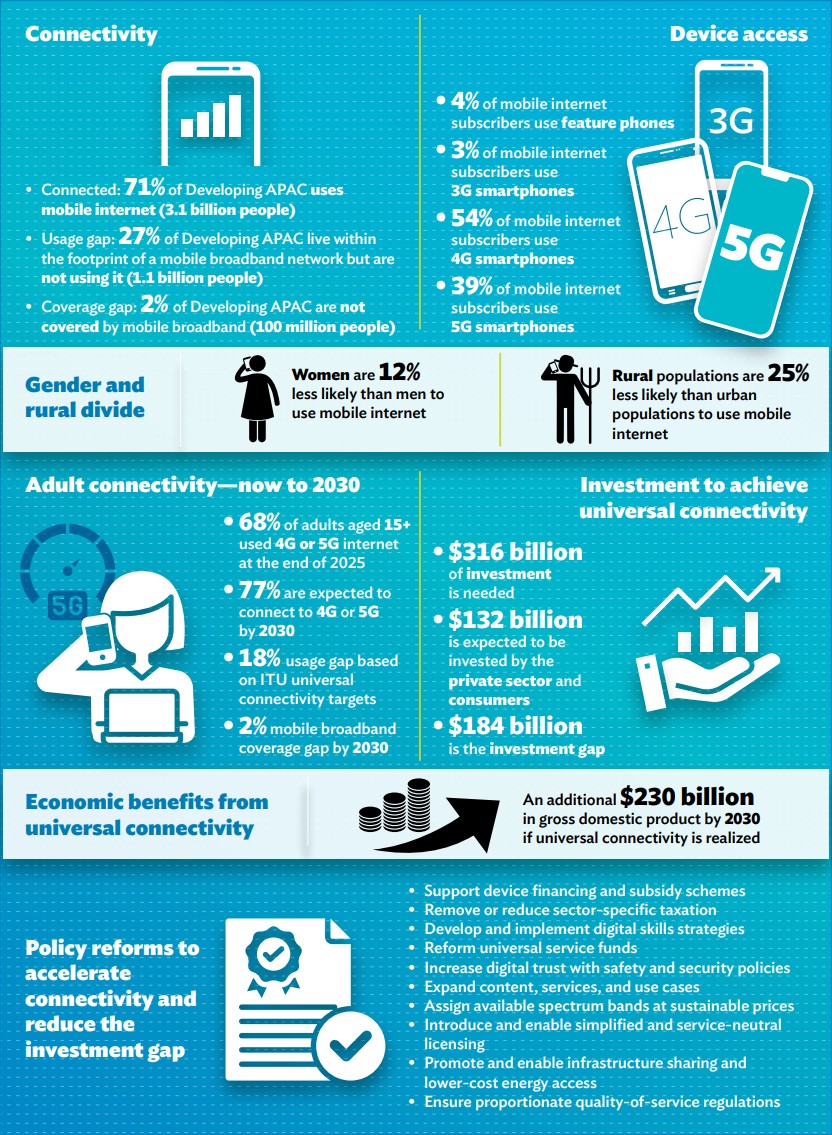
Mobile internet adoption in said region improved from 62% to 71% between 2020 and 2025, yet approximately 1.1 billion people who live within reach of a broadband signal still choose not to or are unable to go online. The key barriers identified include device affordability, limited digital skills, safety and security concerns, and a lack of locally relevant content.
The connectivity gap is not evenly distributed across the region. East Asia records a mobile internet usage rate of 93%, driven largely by China, while the Pacific Islands (including Papua New Guinea and Solomon Islands) sit at just 36%. The Pacific Islands also face a significant coverage gap of 16%, and Central and West Asia (such as Pakistan) trails with an 11% coverage gap.
Southeast Asia stands out as the fastest-growing sub-region, with mobile internet penetration rising by nearly 20 percentage points over five years to reach 76% by end-2025. Malaysia, Thailand, and Vietnam are cited as leading markets in this growth. Malaysia specifically saw mobile internet adoption grow by 19 percentage points to reach 84% of the population, representing 29.6 million users; however, despite 98% 4G population coverage in Malaysia, a 14% usage gap remains.
A technological divide also persists within the region: While 93% of mobile internet users in Developing APAC connect via a 4G or 5G smartphone, 7% still rely on 2G feature phones or 3G smartphones. In Central and West Asia, that figure rises to 23%, and in the Pacific Islands it reaches 59%. Countries where more than 90% of users are on 4G or 5G networks report 50% higher data usage per user compared to those with lower adoption rates.
Gender and geography continue to be key fault lines, too – women in the region are 12% less likely to use mobile internet than men, with the Pacific Islands and South Asia recording gender gaps of just over 25%. Rural residents are 25% less likely to be online than their urban counterparts.



Without additional investment beyond current planned levels, Developing APAC is projected to fall 18 percentage points short of the ITU’s 2030 universal connectivity target. The report estimates that at least $316 billion must be invested across the region to meet that goal. The private sector and consumers are expected to contribute $132 billion, leaving an investment gap of $184 billion that will require government and regulatory intervention alongside additional financing.
The economic incentive for closing this gap is substantial. The report estimates that closing the 4G connectivity gap by 2030 would deliver a GDP uplift of approximately $230 billion across Developing APAC. Broader socioeconomic benefits are also projected, including poverty reduction, improved access to education and healthcare, better humanitarian assistance delivery, and reduced carbon emissions.
Pokdepinion: A billion people within reach of 4G but still offline is less a tech problem and more a reminder that coverage bars on a map mean nothing if you cannot afford the phone.