


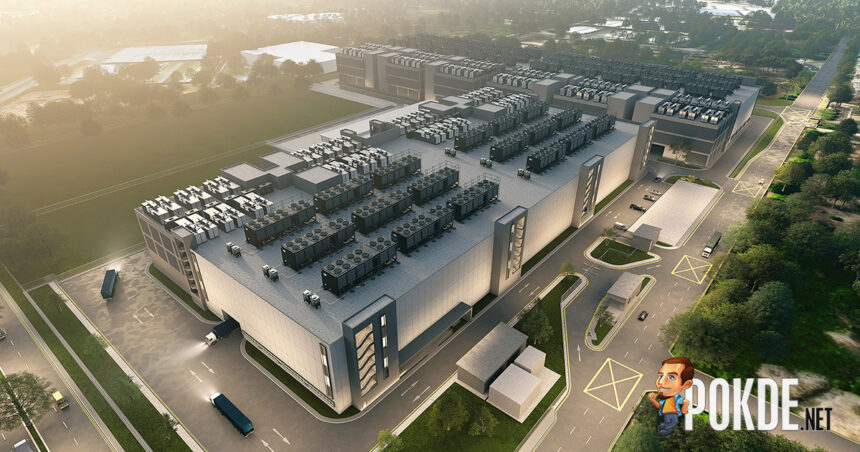
AirTrunk says it has secured US$2.325 billion (RM9.5 billion) in green financing to support the sustainable development of its JHB2 hyperscale datacenter campus in Johor Bahru, marking the largest green project finance transaction for a single datacenter in Malaysia and the largest single-asset financing in AirTrunk’s history. The deal was structured under the company’s Green Financing Framework and backed by a consortium of 30 local and international financial institutions.
AirTrunk Plans Out JHB2 Sustainability Efforts
The JHB2 campus is designed to achieve a Power Usage Effectiveness (PUE) of 1.37, placing it among the most energy-efficient datacenters in the region; the facility claims use of advanced water-efficient cooling technology to ensure minimal disruption around the vicinity – which we argue has been somewhat plagued by water supply issues as of late, and the state has since made appropriate policy changes to ensure water remains undisrupted.
AirTrunk’s Senior Director of Treasury Loans, Edmund Tan, noted that the transaction is structured around transparent environmental key performance indicators and supports the company’s pathway to net zero by 2030. AirTrunk Vice President and Country Head for Malaysia, Pei Jet Lim, described the financing as a demonstration of responsible digital infrastructure development that prioritizes energy and water efficiency.
The IFC’s Regional Industry Director for Infrastructure and Natural Resources for Asia Pacific, Vikram Kumar, stated that digital infrastructure must be built sustainably, and that the green loan delivers measurable environmental outcomes while strengthening Malaysia’s digital economy. Representatives from Credit Agricole CIB, DBS Bank, ING Bank, and HSBC all highlighted the transaction as a benchmark for sustainable datacenter financing in the region.
Margin savings generated through the AirTrunk JHB2 green financing will fund a range of community initiatives in Malaysia. These include recycled water programs in schools delivered through Gravity Water and Water Watch Penang, disaster relief efforts via MERCY Malaysia, and STEM education initiatives in partnership with Universiti Teknologi Malaysia (UTM).
Pokdepinion: Efforts has been made to make datacenters as minimally disruptive as possible, but water is only one of the many sides of this equation that nobody seems to be able (or willing) to completely solve right now.