
AMD and Microsoft have announced an expanded partnership to deliver a full stack of AMD AI solutions across Microsoft Azure, involving its datacenter Instinct GPUs, EPYC processors, and Pensando series of DPUs, with Microsoft also committing to a large-scale deployment of AMD Helios on its Azure platform.
AMD-Microsoft Azure Partnership Brings All-AMD Hardware
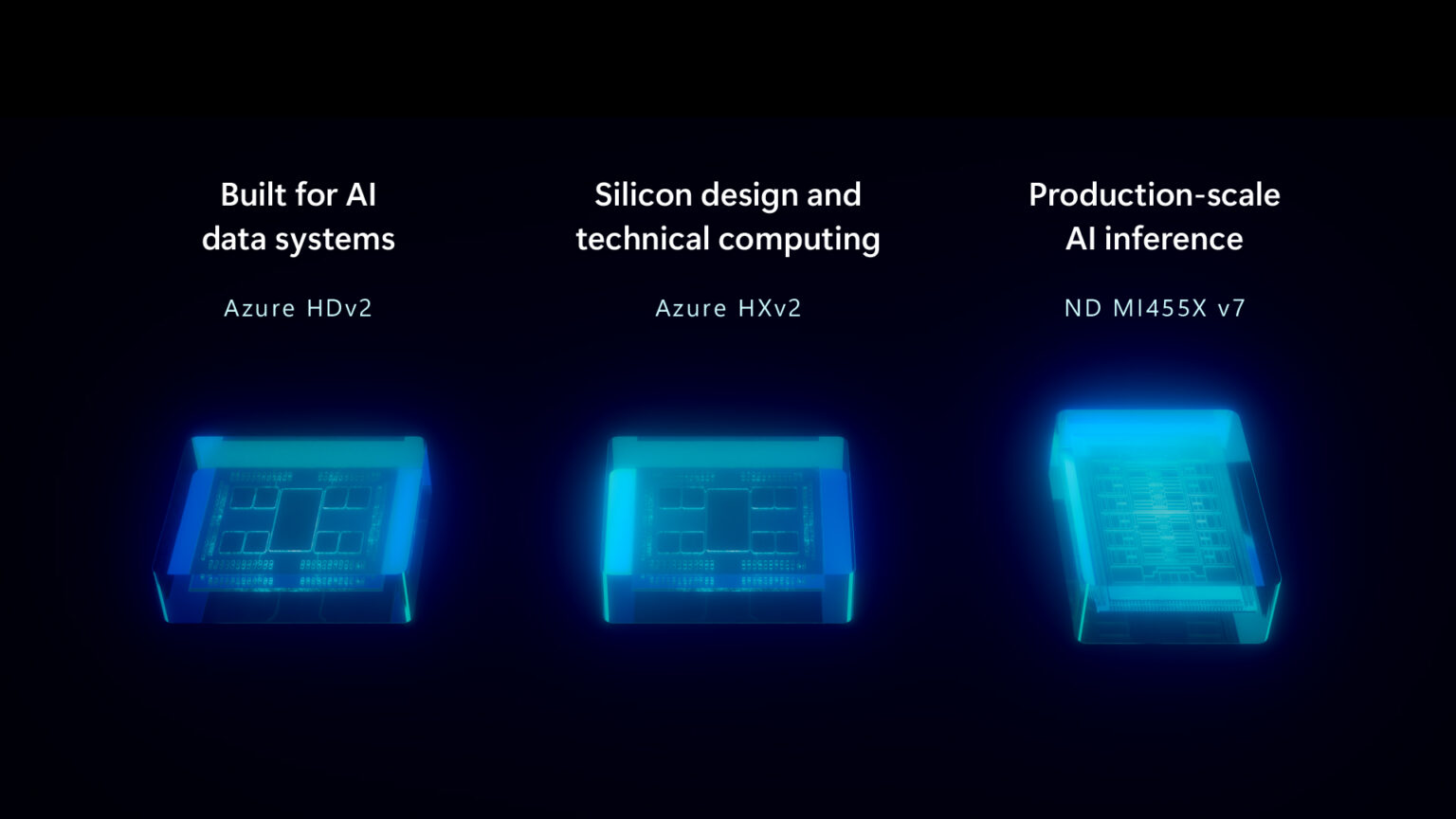
The expanded agreement covers multiple layers of hardware: AMD Instinct GPUs will serve as the compute backbone for AI workloads on Azure, while AMD EPYC processors handle general-purpose server tasks, whereas AMD Pensando DPUs round out the stack, providing high-performance data movement between workloads. Microsoft’s scale deployment of AMD Helios – its latest AI accelerator platform – is also part of the announcement.
Beyond the AI accelerator side, Microsoft will adopt 6th Gen AMD EPYC processors to power two new Azure virtual machine families. The first, Azure HDv2, is designed specifically for agentic AI workloads, while the second, Azure HXv2, targets semiconductor design workflows, a compute-intensive use case that benefits from the high core counts and memory bandwidth that EPYC processors offer.
The Azure HDv2 VM family is positioned for agentic AI, where AI systems execute multi-step tasks autonomously rather than responding to single prompts. This type of workload demands sustained compute throughput and low-latency memory access, both areas where AMD EPYC processors have historically been competitive at the datacenter level. Meanwhile, Azure HXv2 addresses the needs of chip design teams running electronic design automation (EDA) tools – something that AMD knows very well as a chipmaker itself.
Pokdepinion: All the planning between late 2010s and early 2020s seemed to have paid off for AMD to have the capability to provide full-stack solutions.