


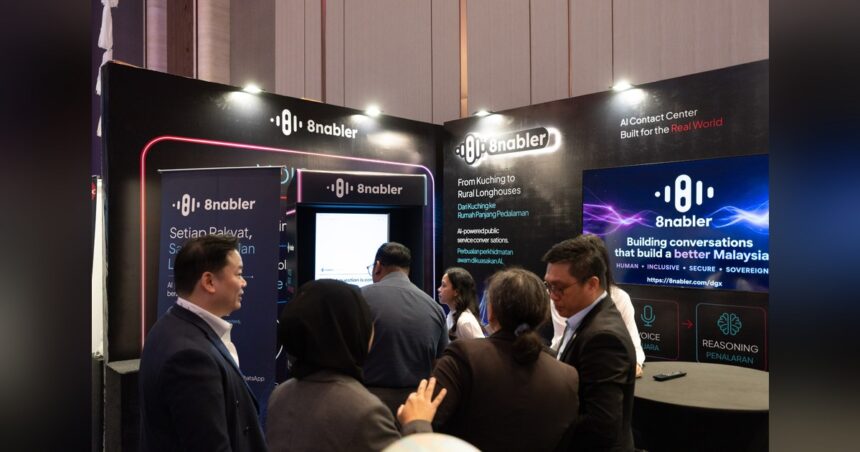
Sarawak Information Systems (SAINS) and Malaysian voice AI firm 8nabler have signed a Memorandum of Understanding (MoU) to explore deploying voice AI across public-facing government services in Sarawak. The agreement, formalised at the Digital Government Exchange 2026 (DGX26) in Kuching on 11 September 2026, positions the SAINS and 8nabler partnership as a vehicle to expand round-the-clock multilingual ICT support for citizens and civil servants statewide.
SAINS and 8nabler Voice AI Already Proven at Operational Scale
The partnership is not starting from zero. Before the MoU was signed, 8nabler’s voice AI had already completed a proof-of-concept deployment within SAINS, handling 4,056 ICT support calls for civil servants entirely without human assistance over two months. During that period, the system automated 4,702 minutes of call time, operating around the clock including weekends and public holidays.
The system demonstrated the ability to understand mixed Bahasa Malaysia and English requests, a practical requirement for government contact centres serving Sarawak’s linguistically diverse population. The results gave both parties sufficient confidence to formalise the collaboration and begin scoping broader use cases.
At the heart of the deployment is 8nabler’s Panacea platform, a conversational AI system built for secure, governed voice and chat interactions in regulated environments. It brings together speech generation, reasoning models, and telephone network integration into a single real-time system, and supports deployment in air-gapped private cloud or fully on-premise configurations for organisations with strict data residency requirements.
Bridging the Digital Divide Through Multilingual Voice Access
A central motivation behind the MoU is the challenge of reaching citizens who struggle with text-based digital services. Poor internet connectivity, disability, language barriers, and low digital literacy can make online forms and government portals inaccessible for significant portions of the population, particularly those in rural areas and longhouse communities across Sarawak.
Voice-based access addresses this by allowing citizens to interact with services through natural speech rather than written input. For SAINS, which operates as the state’s primary ICT backbone, pairing its reach across state and federal agencies with 8nabler’s multilingual voice infrastructure offers a path to government-scale deployment rather than incremental, agency-by-agency rollouts.
The MoU commits both parties to a scoping and testing phase, identifying use cases across SAINS-supported application systems and services where voice AI can extend existing digital and assisted-service channels. Human escalation remains part of the model, with the AI handling routine queries and freeing human teams to focus on complex or sensitive cases.



8nabler’s platform currently serves more than 500,000 minutes of voice talk time per month across government agencies and financial institutions, indicating the infrastructure is already operating at production scale in mission-critical environments beyond this specific partnership.
Pokdepinion: If the government’s big digital push still can’t reach someone in a longhouse, maybe the fix really was just letting them call.