
Let me start with something that has nothing to do with tech, and everything to do with why this article exists.
I recently moved house. My new place sits right on the edge of Klang Valley, close enough that the nearest school for my kids is technically within Klang Valley, but my address falls under different jurisdiction. So when it came time to switch my children’s school, I couldn’t just walk in and enrol them. I had to go through PPD Klang, hat in hand, and ask on their behalf.
My children didn’t get the school we wanted. I applied for them, specifically, hoping to give them the best shot at a good few years of schooling in our new area and I was told the school I picked was “overcrowded.” They were assigned a different one instead, further from our house than the one I’d originally asked for. Off the record, I got the distinct impression the officer wasn’t thrilled that a family from another jurisdiction was trying to get their kids into a Klang Valley school in the first place, and that the alternative placement was less “here’s a solution for your children” and more “we’re doing your kids a favour.” I’m not going to fight that battle publicly, especially not when my children’s school placement is the thing on the line. But “overcrowded” stuck with me. It’s the kind of word that ends conversations. Nobody argues with “overcrowded.” It just becomes the reason nothing else is possible for your kids.
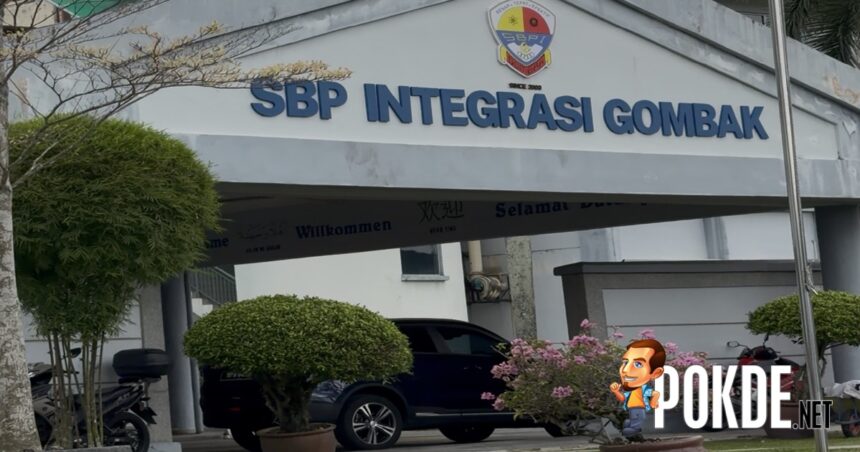
So when I got the chance to visit SBPI Gombak (Sekolah Berasrama Penuh Integrasi Gombak), consistently ranked among Malaysia’s top 10 schools and saw how their classrooms actually run on iPads, that word came right back to me. Because what I saw there was a pretty direct answer to the overcrowding excuse, just not the answer PPD Klang gave my kids.
Smaller classes, sure, but that’s not actually the takeaway
SBPI Gombak’s classes aren’t massive to begin with, so it would be easy to write this off as “well, small class, of course the tech works well.” But that misses the more interesting point. What stood out watching these teachers work wasn’t that the iPads worked well because the class was small but rather it’s that the way the tools were being used meant the teacher could plausibly handle a much bigger class without losing control of what each individual student was doing. The device wasn’t compensating for a small class. It was removing a lot of the reasons class size becomes a ceiling in the first place.
That’s the bit worth sitting with if you’ve ever been told, about your own kids, that a school is full.
Three classrooms, three completely different uses
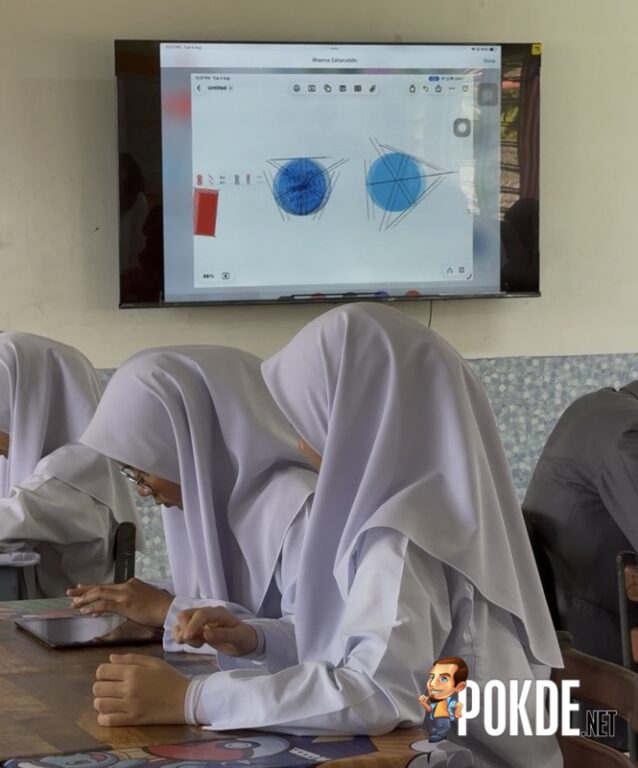
I sat in on a Japanese language class, a maths class, and somewhat unexpectedly, a Pendidikan Jasmani dan Kesihatan (PJK) session. Same device, three completely different jobs.

![[Updated: Pricing] COROS PACE 4 Pro Now Available With Larger Display And Longer Battery Life - 39](https://cdn.pokde.net/wp-content/uploads/2026/10/14185816/corospace4procover-330x220.jpg "[Updated: Pricing] COROS PACE 4 Pro Now Available With Larger Display And Longer Battery Life - 40")

Maths – circles and radius, but nobody had the same worksheet. The topic was circumference and radius, and instead of a shared worksheet, every student picked an object they had physically on hand; a water bottle, a coin, whatever was in reach and had to measure its radius and circumference themselves. Same learning objective, but every student’s actual task was different because their object was different. The teacher wasn’t managing one lesson; she was managing thirty personalised ones running in parallel, and the iPad was what made checking each one in real time feasible instead of a logistical headache.
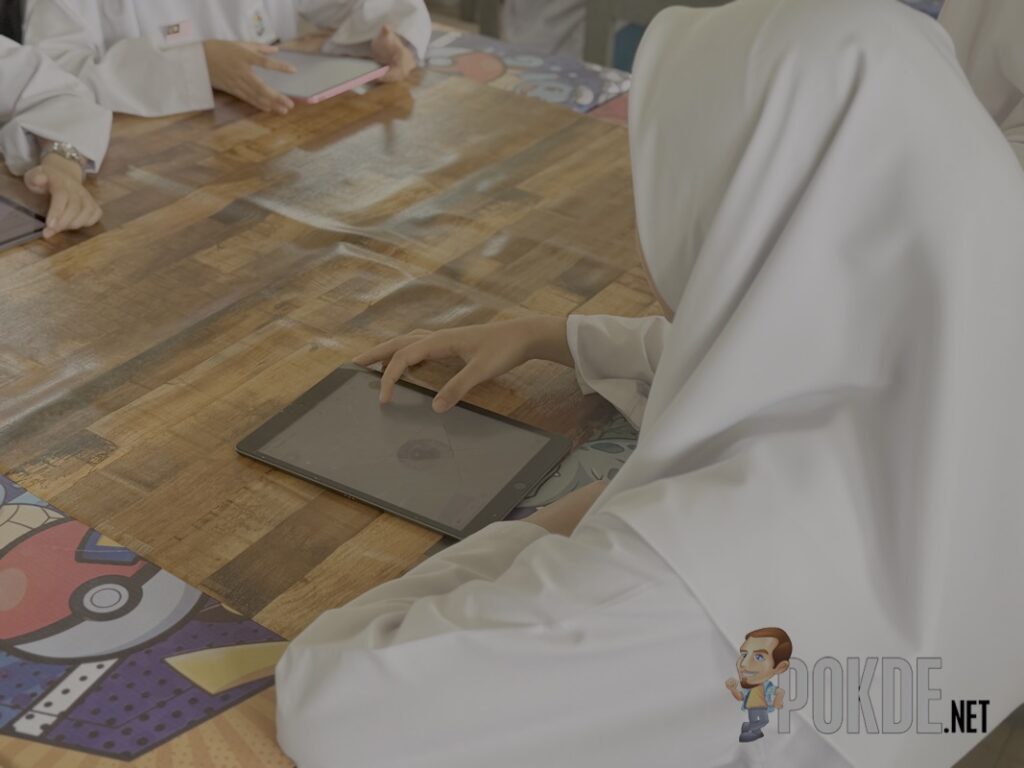
Japanese – translation without breaking the lesson’s pace. Words displayed on screen could be looked up and translated almost instantly, which meant the class didn’t stall every time a student hit an unfamiliar term. In a language class, that’s a bigger deal than it sounds, momentum is everything, and the usual choice is either slow the whole room down or let confused students quietly fall behind. Here, neither had to happen.

PJK – jumps, lifts, and a dashboard nobody had to build by hand. This was the one I didn’t expect. Students doing jumps and lifts had their movement tracked live, with posture and performance data flowing into an analytics dashboard the teacher could actually read and act on. PJK is usually the subject where feedback is a shouted correction from across the field, if it happens at all. Turning it into something measurable, in real time, is a genuinely different way to teach a subject that’s historically resisted being taught with any precision.

The part parents don’t see: how these teachers got this good
None of what I watched happens because you hand a teacher a box of tablets and walk away. What was clear talking to the staff at SBPI Gombak is that the personalisation I saw in the maths class, and the fluency with which the Japanese and PJK teachers moved between the device and their students, is the product of actual training pipelines behind the scenes.

A lot of it traces back to Apple Teacher, a free, self-paced professional learning programme that helps educators build real skill with iPad and Mac rather than just handing them the hardware – one recognised by the Ministry of Education Malaysia for teacher professional development, which is why it’s not just a nice-to-have badge but something that plugs into how teachers here are formally upskilled.

Above that sits Apple Learning Coach, aimed at instructional coaches rather than classroom teachers directly. A mix of self-paced lessons, live virtual workshops, and hands-on creative projects. Since it launched in Malaysia in June 2024, thousands of educators have gone through it, and a chunk of them have come out the other side as certified coaches whose actual job is training fellow teachers to get more out of the same tools I was watching in the classroom. It’s effectively a multiplier program. MOE gets its teachers upskilled without every single teacher needing to go through the same pipeline individually. There are already success stories coming out of the programme worth reading if you want the coaching side in more depth.

And then there’s the Apple Distinguished Educators track, which recognises K-12 and higher ed teachers who are actively rethinking what a lesson can look like with iPad and Mac, rather than just running the syllabus with a shinier tool. These are the educators pushing what “personal learning” even means at scale. In other words, the ones the maths and Japanese classes I sat in on are downstream of.
The safety question every parent actually has
Here’s the honest thing: as a parent who just went through a bruising process trying to get my kids into a specific school, my instinct with any new classroom technology is suspicion first, enthusiasm second. Handing a child a connected device raises the obvious question; “Who’s actually in control of what that device does”?
SBPI Gombak’s setup made that clearer than I expected. Devices used at school run under a different management model than the ones a family would set up at home which is a distinction that matters more than it sounds. Institutional device management is built around what apps can be used, which features are switched on, how the device connects to the school network, and how privacy and security are maintained across an entire fleet of devices, not just one kid’s iPad on a home Wi-Fi network. It’s a fundamentally different job from parental controls at home, and seeing it explained made it obvious why schools shouldn’t just be handing out consumer-configured devices and calling it a day.

On the home side, there’s also a new suite of parental tools in the pipeline aimed at making it easier for parents to build safer digital experiences for their kids which was announced but currently in beta, expected to roll out with the Screen Time update in iOS 27, iPadOS 27, and macOS 27, with the usual caveat that beta features are subject to change before general availability. For a parent, that’s the more relevant half of the equation: the school can lock down what happens in the classroom, but what happens on the device once it’s back in a kid’s hands at home is still largely on us.
Why this matters more than “cool gadgets in class”
It’s tempting to write this kind of visit off as a novelty piece as “look, kids have tablets”. But the actual story is about capacity, and about the infrastructure of training and control sitting underneath the classroom that most parents never get to see. A teacher who can give thirty students thirty different maths problems, translate on the fly without breaking pace, and see posture data mid-exercise is a teacher who can absorb more students without every one of them becoming invisible in the crowd; and that teacher didn’t get there by accident. There’s a whole professional development pipeline, and a whole device management layer, making it possible.
Which brings me back to PPD Klang and the overcrowding excuse they gave my children. I’m not naive enough to think a tablet solves a national school capacity problem. That’s an infrastructure and policy issue, not a hardware one. But watching SBPI Gombak work made it obvious that “overcrowded” isn’t the fixed ceiling it’s often treated as. It’s a function of how much a single teacher can realistically track and personalise for, how well-trained that teacher is on the tools in front of them, and how well those tools are managed behind the scenes. Change any of those three, and the number of kids one classroom can actually serve well changes with it.
My children still didn’t get the school we wanted. But I left SBPI Gombak with a clearer sense of what a school that’s actually solving for scale looks like and it’s not what PPD Klang told us was impossible.
Pokdepinion: Where there’s a will, there’s a way.