
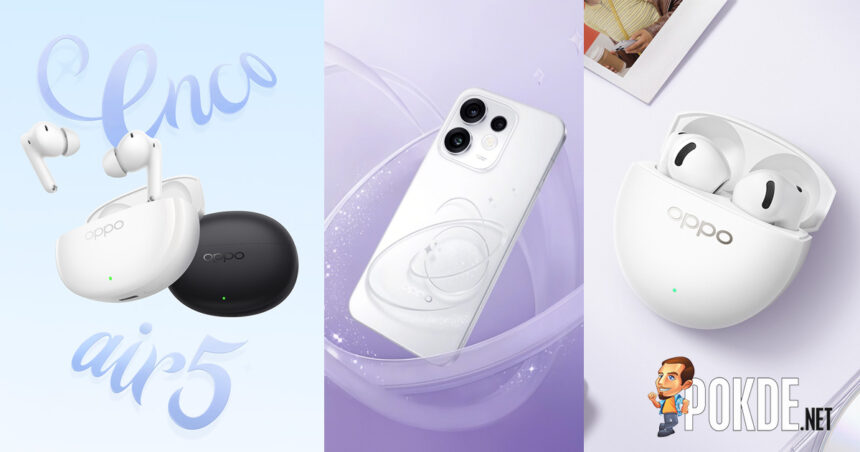
OPPO has introduced the Reno16 Series, comprising the Reno16, Reno16 Pro, and Reno16 F, alongside two new earbud models, the Enco Air5 and Enco Air5s, in Malaysia. The new Reno lineup combines a 3D Pop Planet Design with new AI-powered imaging tools, while the two earbud models focus on active noise cancellation (ANC) and battery life.
Oppo Reno16 Series Introduces 3D Back Cover Design

Design-wise, the Oppo Reno16 series’ new 3D Pop Planet Design is the highlight, with the Pop White color option using its HoloVerse 3D Technology to create a floating visual effect through microlenses; a one-piece cold-sculpted back cover integrates with the camera module to complete the looks. Generally, the smartphones stay on the smaller side, with the Reno16 and Reno16 Pro using a 6.32-inch AMOLED displays, while the Reno16 F offers a larger 6.57-inch equivalent.
All three models include a 50MP ultrawide selfie camera with a 100° FOV, along with a rear triple-camera system featuring a main camera with OIS, a telephoto portrait camera with 3.5x optical zoom, and an ultrawide camera; the Reno16 Pro in particular features a 200MP main camera, while the Reno16 F’s ultrawide is replaced with an 8MP sensor instead. A new “Pop Cam” feature applies vintage-inspired styles such as Digicam and Instant Film, while a Create hub in the Photos app introduces AI Remix Collage and Popout Collage 2.0 for combining and editing photos and videos.

Battery capacity on the standard and Pro models are rated at 6,700mAh, while the Reno16 F features a slightly bigger cell at 7,000mAh, all of which are paired with 80W SUPERVOOC fast charging. The Pro model uses the MediaTek Dimensity 8550 Super chipset, while the standard model uses the Snapdragon 7 Gen 4, and the F variant sticks to MediaTek Dimensity 7300 Energy instead. All models carry IP68, IP69, and IP69K water and dust resistance ratings. Perhaps surprisingly, the Reno16 F also gets an microSD card slot while the other two models do not.
Alongside the phones, OPPO is introducing an accessory called “OPPO Bubble”, which is a 35-gram magnetic accessory with an AMOLED display that functions as a rear-camera monitor and remote shutter control from up to 10 meters away, compatible with the Reno16 Series and OPPO’s flagship Find X9 Series.
Oppo Enco Air5 & Enco Air5s Bring ANC To Two Price Points
Besides the smartphones, Oppo also launched Enco Air5s, its first semi-in-ear earbuds with ANC, alongside Enco Air5, a higher-capacity ANC model. Both earbud models carry IP55 water and dust resistance along with TÜV Rheinland battery durability certifications.

The Oppo Enco Air5s features real-time ANC technology with an 800kHz sampling rate for vocal-frequency suppression; each earbud weighs 3.9 grams and uses a 12mm dynamic driver with a 10-band custom EQ for tuning. Battery life is rated for up to 9 hours on each earbud with ANC off, or 48 hours with the charging case – said figures are roughly halved in ANC and transparency modes.




As for the Oppo Enco Air5, it features a dual-feed ANC architecture with a three-microphone system per earbud, reducing noise by up to 52dB across a 5000Hz frequency range. Each earbud weighs 4.3 grams and uses a 12mm dynamic driver, with Bluetooth 6.1 and support Tap to Launch gestures for AI Translate, Google Gemini, or Spotify. For this model, battery life without ANC reaches up to 54 hours with the charging case, and each earbuds lasts 13 hours; again, ANC and transparency mode cuts the figures in half.
Pricing and Availability
The Oppo Reno16 Pro, in the sole 12GB+256GB configuration, is priced at RM3,699 and comes in Pop White and Starlight Black. The Reno16 and Reno16 F starts from RM2,699 and RM1,999 respectively in 8GB+256GB or 12GB+256GB configurations, available in Pop White, Twilight Violet, and Dream Purple options. As for the earbuds, the Oppo Enco Air5s is priced at RM299, while Enco Air5 is priced at RM249. All products are available now across Malaysia.
Pokdepinion: Maximum points in the looks department, we suppose – although it stays true to the general trend that rear cover is where visual differentiations happen.