

Product Name: Pulse Radeon RX 9070 GRE
Brand: SAPPHIRE
Offer price: 2399
Currency: MYR
-
Appearance - 8/108/10
-
Efficiency - 7.5/107.5/10
-
Features - 7/107/10
-
Materials - 8/108/10
-
Performance - 8/108/10
-
User Experience (UX) - 8/108/10
-
Value - 7.5/107.5/10
Summary
The SAPPHIRE Pulse Radeon RX 9070 GRE fills the gap in between RX 9070 and RX 9060 XT, though 12GB VRAM may not be as long-lasting as 16GB offerings in aforementioned SKUs.
Overall
7.7/10Pros
+ Runs cool and quiet + Decent 1440p performance
Cons
– Lacks dual BIOS option – 12GB VRAM could be a concern in the near future
Unboxing


AMD just announced the “new” Radeon RX 9070 GRE graphics card (more so an official global release than a new product reveal per se), with the once Chinese-exclusive model slotting below the vanilla RX 9070 and above the RX 9060 XT. As standard, no first-part cards were made for this entire generation of Radeon GPUs, so the unit we received from AMD to check out is from SAPPHIRE, with the beefed-up version in Pulse which offers higher TBPs than standard.
Walkaround


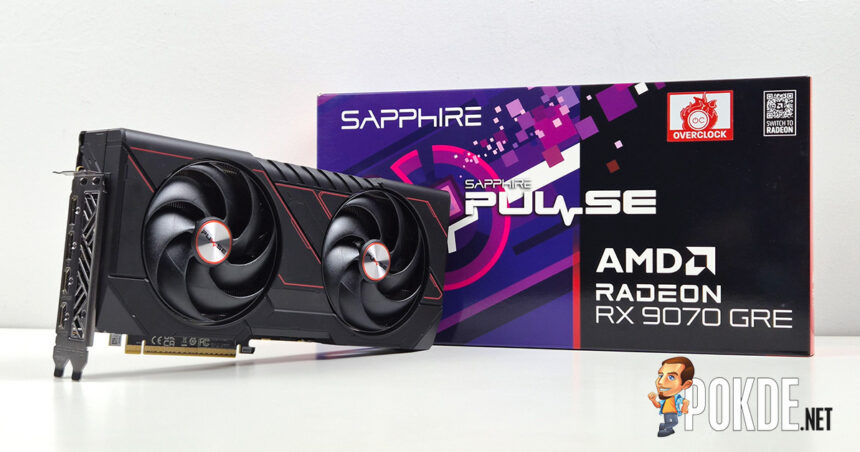
Since the last time we reviewed a SAPPHIRE-branded card, not a lot has changed in terms of design. It’s the usual black-and-red combination well known under the Pulse lineup, though the fan design has changed a bit with contemporary fan blade design that is quite proven these days. It’s a lengthy card by dual-fan standards, though it shouldn’t have any trouble cooling the Navi 48 silicon drawing up to 240W of total board power (which is pretty much the same figure as the standard, more powerful RX 9070, like this one).


Side profile views reveals a few things: Generous amounts of metal inside to maximize surface area, two PCIe 8-pin power connectors, and chonky thermal pads that makes adequate contact against components like GDDR6 VRAM. SAPPHIRE says it uses Honeywell PTM7950 thermal pad – known for excellent heat transfer and phase-change capability which avoids spillage like liquid metals do – for interfacing with the silicon itself. Note that while this card is technically factory-overclocked, you won’t find dual BIOS feature onboard this card.

For I/O, SAPPHIRE opted for an unconventional setup of two HDMI 2.1b outputs alongside two DisplayPort 2.1a outputs. Both are capable of delivering 8K resolutions on paper, which shouldn’t matter too much if you do run a triple-monitor setup. In this view we can also see the card’s thickness, at around 2.5 slots thick.
Specifications
SAPPHIRE Pulse Radeon RX 9070 GRE
Full specifications available on product specification page.
| GPU Core & VRAM: AMD Radeon RX 9070 GRE | |
| GPU Core Variant | Navi 48 XL |
| Microarchitecture | RDNA 4 |
| Process Node | TSMC N4P |
| Transistors | 53.9 billion |
| Die size | 357mm² |
| Compute Units (CUs) | 48 |
| ROPs / TMUs | 96 / 192 |
| Stream Processors | 3072 |
| AI Accelerators | 96 |
| RT Accelerators | 48 |
| Cache | 48MB L3 (Infinity Cache) |
| VRAM Configuration | 12GB GDDR6 192-bit |
| Memory Bandwidth | 18Gbps, 432GB/s peak |
| Add-in board: SAPPHIRE Pulse Radeon RX 9070 GRE | |
| Fan Layout | Dual front axial fans (single flow-through) |
| Game/Boost Clocks | 2220 / 2790 MHz |
| Total Board Power (TBP) | 240W |
| Factory Recommended PSU | 650W |
| Dual BIOS Mode | No |
| Display Outputs | 2x DisplayPort 2.1a 2x HDMI 2.1b *Max output resolution: 7680×4320 (8K) |
| Power Connector | 2x PCIe 8-pin connector |
| Bus Interface | PCIe 5.0 x16 |
| Dimensions | 2.5-slot, 280 x 120.5 x 51.5 mm |
Test System
| CPU | Intel Core i9-14900K |
| Cooling | Cooler Master MasterLiquid PL360 Flux 30th Anniversary Edition Thermal Grizzly Kryonaut |
| Motherboard | ASUS ROG Maximus Z790 Dark Hero |
| GPU | > SAPPHIRE Pulse Radeon RX 9070 GRE |
| Memory | ADATA XPG CASTER DDR5-6000 CL30 (2x16GB) *configured to DDR5-6400 CL32 |
| Storage | ADATA XPG MARS 980 BLADE 1TB |
| Power Supply | Cooler Master MWE Gold 1250 V2 Full Modular (ATX12V 2.52) 1250W |
| Case | VECTOR Bench Case (Open-air chassis) |
| Operating System | Windows 11 Home 25H2 |
Performance
Synthetic Benchmarks

We pit the SAPPHIRE card against three other models, the GIGABYTE Radeon RX 9070 OC 16GB, PowerColor Reaper RX 9060 XT 16GB, and ASUS TUF Gaming RTX 5060 Ti OC Edition 16GB. Thanks to a quirk in the GPU market, both mid-range models from AMD and NVIDIA has offered 16GB VRAM for their 60-class models, which means the SAPPHIRE Pulse RX 9070 GRE actually features the least amounts of VRAM among all four, at 12GB. As far as synthetic benchmarks ago, nothing suggests 12GB is a bottleneck just yet.
Gaming Benchmarks

Before we look at performance comparisons, here’s a quick look on what kind of performance you can expect out of this card. AMD advertises the Radeon RX 9070 GRE as an 1440p card, and our data largely matches their claims – provided the game has decent performance optimization and isn’t extremely demanding from a graphics perspective, the new Radeon model can easily get away with 100+FPS even with Ultra settings. That being said, having just 12GB of VRAM is a limitation that will impact it’s longevity sooner than you think.





We welcome a new addition in our testing suite in Forza Horizon 6, and while it is generally regarded as low-end friendly for its proprietary ForzaTech engine, turning the knob way up can still demand quite a lot out of your system. In pure raster graphical settings, the Radeon RX 9070 GRE is well ahead of both RX 9060 XT and RTX 5060 Ti, getting pretty close to the vanilla RX 9070 – that said, that gap generally shortens for the NVIDIA card once Ray Tracing is introduced into the equation.
Earlier we mentioned the longevity issue of the card’s 12GB VRAM, and there’s one data point in our benchmarks that points to such. Notice the framerates of Cyberpunk 2077 absolutely crashes down to single-digit values in 4K resolution, to the point it is slower than the cheaper cards. That’s where the card’s video memory is fully exhausted and that could spell trouble for the card in handling future titles (until a tech like NVIDIA’s Neural Texture Compression saves the day, that is), and we already seen the numbers getting pretty close in Forza Horizon 6, which was launched last month.
Thermals


Don’t let the card’s dual fan setup fool you into thinking the cooling was scarified in one way or another, as SAPPHIRE has delivered a card that is truly well-cooled in both conditions, with GPU temperature only reaching 56°C at most, whereas memory and hotspot only reached 74°C and 76°C at most. Keep in mind this is a 240W card, which draws slightly more power than the base 220W figure (which you’ll likely see in entry-level variants from other brands).
The fans behavior is pretty conservative based on our observations, only ramping out of 0 RPM mode when there’s actually enough workload to saturate the heatsinks, instead of actively pushing air out as soon as heavy workload is detected. In any case, it’s very quiet at the highest speed it’ll realistically operate, which is around 1700 RPM.
Software


SAPPHIRE does have its software called TRIXX which allows you to monitor and change some GPU settings as needed, no installation required (though you do need to install it if you want to save settings across system reboots). Generally, it’s not necessary to use since AMD Software has way more granular controls over things like fan behavior – better than some of the software out there, we might say – so we suggest just stick to what’s given from your AMD driver install.
Verdict

As announced by AMD yesterday, the Radeon RX 9070 GRE costs $549 at launch, and the SAPPHIRE Pulse variant follows that price tag as well. (We’re told local pricing is RM2,399, too). We would say the pricing looks comparatively suboptimal if this card launched last year – but when the entire PC industry is having massive pricing inflation across the board, the price doesn’t look too terrible if you absolutely needs a new card right now.

Granted, one thing you’ll need to take into account is longevity, which is now more important than ever as gamers try to survive this winter; 12GB VRAM in today’s climate is going to limit the card’s capability in the long run, we think, as games pushes VRAM usage even more aggressively over time with seemingly no signs of weight-saving measures being done. It’s a bit of an awkward spot for the GRE, but it does fill the large performance gap between both cards acting as an alternative among the mid-range and upper-mid-range offerings.

Special thanks to AMD Malaysia for providing the SAPPHIRE Pulse Radeon RX 9070 GRE for this review.
![[COMPUTEX 2026] AMD Announces Ryzen 7 7700X3D, 5800X3D 10th Anniversary Edition & Radeon RX 9070 GRE - 86](https://cdn.pokde.net/wp-content/uploads/2026/06/01011028/amdcomputex2026cover.jpg "[COMPUTEX 2026] AMD Announces Ryzen 7 7700X3D, 5800X3D 10th Anniversary Edition & Radeon RX 9070 GRE - 87")
![[COMPUTEX 2026] NVIDIA Announces RTX Spark Processor For Windows PCs - Essentially A Rebadged GB10 Superchip - 88](https://cdn.pokde.net/wp-content/uploads/2026/06/02213800/nvidiartxsparkcover.jpg "[COMPUTEX 2026] NVIDIA Announces RTX Spark Processor For Windows PCs - Essentially A Rebadged GB10 Superchip - 89")