

Product Name: Note 17 Pro Max
Brand: REDMI
Offer price: 1999
Currency: MYR
-
Appearance - 7.5/107.5/10
-
Efficiency - 10/1010/10
-
Features - 7.5/107.5/10
-
Materials - 8/108/10
-
Performance - 7/107/10
-
Portability - 7.5/107.5/10
-
User Experience (UX) - 7.5/107.5/10
-
Value - 8.5/108.5/10
Summary
Battery anxiety issues? The REDMI Note 17 Pro Max officially puts an end to that with its record-breaking battery life.
Overall
7.9/10Pros
- Huge battery, impressive battery life
- 27W reverse wired charging
- Included 100W fast charger
- Solid display to look at
- Tough durability
- IR blaster still exists!
Cons
- Slightly sluggish performance
- Camera have oversaturation issues
- Many advertising attempts throughout the UI
Unboxing

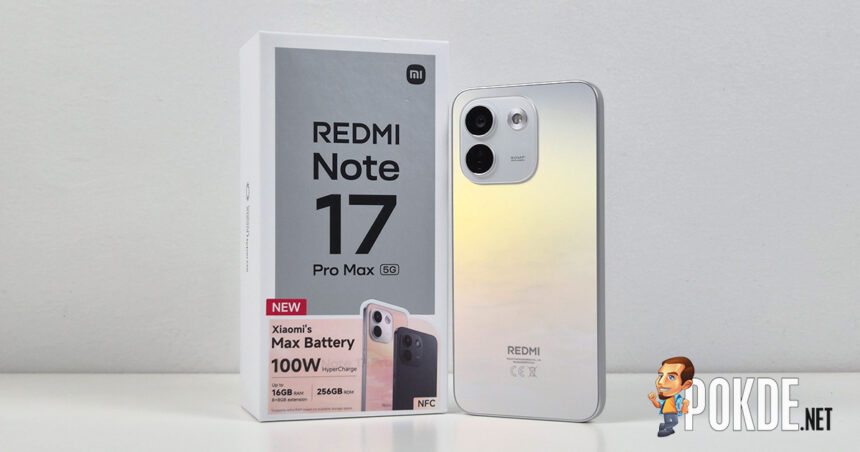
Xiaomi’s budget sub-brand REDMI welcomes a new headliner, the REDMI Note 17 Pro Max; our unit is the top variant among four offered (Pro Max, Pro, vanilla 5G, and vanilla 4G), featuring the biggest battery among them, as well as all the smartphones on sale today, with a gigantic 10,000mAh battery packed inside a smartphone that is no thicker than usual.

The unboxing experience is no different than before, and so do the items included. Here’s what you’ll get out of the box:
– 100W charging adapter (Type C “Europlug”)
– USB-C charging cable
– SIM ejector pin
– Silicone phone case
– Safety information
– Quick start guide & warranty card
– REDMI Note 17 Pro Max smartphone
Walkaround


The REDMI Note 17 has received a major visual makeover, moving away from the center island-style camera bump featured in the two generations prior to a new, but rather overdone, rounded square bump that occupies the top left corner. Not a fan of this personally, but it is what it is.
In any case, in the camera bump of the REDMI Note 17 Pro Max you’ll find a pair of cameras – one 50MP main shooter and one 8MP for ultrawide duties – with the former also featuring OIS stabilization as well (although it’s not quite the 200MP sensor found in the Note 15 Pro). There’s also an LED flash present next to the pair of lenses.


In Malaysia, the REDMI Note 17 Pro Max is offered in three colors, for which the Cloud Blush option is the fanciest of them all. Under specific lighting projections, the back cover displays a gradient effect layered on top of cloud-like graphics, hence the name; the other two color options (Black, Purple) covers the back in solid color and not much else. At the front, the rather large 6.83-inch AMOLED display is surrounded by symmetrical bezels, with flat edges that is nothing out of 2026’s ordinary.


Continuing the theme of 2026 design trends, the frame of the REDMI Note 17 Pro Max is aluminum alloy in its bare colors, where you’ll find an IR blaster and a mic up top, side keys at the right, nothing at the left, and the speaker, USB-C port, SIM tray, plus another mic input at the bottom.
Specifications
REDMI Note 17 Pro Max (8+256GB, 2609FRA74G)
Full specifications available on product webpage.


| Form Factor & Build | Smartphone (candybar) Corning Gorilla Glass Victus 2 front Aluminum alloy frame |
| Chipset | Qualcomm Snapdragon 6 Gen 5 (4nm, TSMC N4) |
| CPU | 8-core (4P+4E) Performance: 4x Arm Cortex-A78 @ 2.6GHz Efficiency: 4x Arm Cortex-A55 @ 2.0GHz |
| GPU | Qualcomm Adreno 812 (256 ALUs) |
| NPU | Qualcomm Hexagon NPU + Qualcomm Sensing Hub |
| RAM | 8GB LPDDR5X [As tested] |
| Storage | 256GB UFS 4.1 512GB UFS 4.1 [As tested] *No microSD expansion support |
| Display | 6.83″ AMOLED 89.5% screen-to-body ratio 2772×1280 (~19.5:9) 120Hz refresh rate Sampling rates: 240Hz standard, 3200Hz instantaneous Brightness: 3500 nits HDR peak, 2000 nits HBM, 1060 nits full panel 3840Hz PWM dimming + DC dimming support DCI-P3 color gamut 12-bit (68.7B) color depth 447 ppi pixel density Dolby Vision support HDR10+ support TÜV Rheinland Low Blue Light (Hardware Solution) Certified TÜV Rheinland Circadian Friendly Certified TÜV Rheinland Flicker Free Certified |
| Audio | Dual stereo speakers 400% volume boost mode Dolby Atmos Hi-Res Audio No headphone jack (USB-C only) |
| Cameras | Rear: Dual-camera – 50MP (26mm wide, 1/1.95″, f/1.5, 90° FOV, PDAF, OIS, 6P lens) – 8MP (15mm ultrawide, 1/4.0″, f/2.2, 120° FOV) Front: Single cut-out camera – 32MP (1/3.6″, f/2.2, 4P lens) |
| Biometric sensors | Fingerprint scanner (under-display optical) |
| Connectivity | Wi-Fi 6 (dual-band 2.4GHz+5GHz) Bluetooth 6.0 360° NFC IR blaster USB 2.0 Type-C |
| Cellular Networks | Dual-standby 2x Nano-SIM / eSIM / mixed 2G: 850/900/1800/1900MHz 3G*: B1/2/4/5/8 4G: B1/2/3/4/5/7/8/12/13/17/18/19/20/26/28/32/38/40/41/42/48/66 5G Sub6: n1/2/3/5/7/8/12/20/26/28/38/40/41/48/66/77/78 5G mmWave: Not supported *3G network has been phased out in Malaysia. |
| Operating System | Android 16 (Xiaomi HyperOS 3) 4 years OS updates, 6 years security updates |
| Battery | 10,000mAh silicon-carbon battery* 100W USB-C (PPS) wired charging 27W reverse wired charging *Some regional versions may feature smaller 9210mAh battery |
| Ingress Protection | IP69K/IP69/IP68/IP66 |
| Colors | Cloud Blush [As tested] Purple Black |
| Dimensions | 163.44 x 78.27 x 8.65 mm (Purple / Black) 163.44 x 78.27 x 8.57 mm (Cloud Blush) |
| Weight | 229.5g |
User Experience


The REDMI Note 17 Pro Max comes with Xiaomi HyperOS 3 UI (based on Android 16) by default, though as usual, you’ll find various attempts of data collection via personalized ads – including a full-screen ad upon opening its File Manager app which I consider very obnoxious – and some of the interface design that I consider user-hostile (i.e. swiping to the right in the lock screen always brings up a prompt to enable Wallpaper Carousel service).
The lack of labels in the quick settings panel is another point of annoyance. Here’s a hot take: smartphone UIs shouldn’t look like Angry Birds, as much as the video game made shooting green pigs a very simple thing to do. It also shouldn’t look like a blatant copy of Apple’s Control Center either – I am still not a believer that this is the best way of displaying quick controls.
Camera


Xiaomi claims the REDMI Note 17 Pro Max comes equipped with “Flagship-Level Camera System” (hyperlinking it just so we have the receipt), though the results suggests otherwise. Taking photos in daylight or bright environments will generally result in overly color-saturated images, and it is especially pronounced in the examples shown above.
The first one is in a hotel lobby which is adequately lit (FYI, it was at night when the photo was taken), but the result looked like the flower had been subjected to floodlights all around; the second example was shot at sunset, which you almost certainly couldn’t notice if I hadn’t told you just now. Just to show how its camera struggles with lighting, here’s another photo taken in the exact same conditions as the second photo (in this case it ended up very underexposed):

Both the third and fourth photo demonstrates wide dynamic ranges ranging from shadows to surfaces directly lit by sunlight. Notice the coconut tree in the third photo and the tree in the center of fourth photo becomes severely oversaturated as a result.


Due to its small size, the 50MP sensor almost always requires extra exposure times to take photos even in a reasonably well-lit night scene, and we have examples above. Credit where its due, the result is passable in the zoom tests, there’s no obvious flaws aside from the very common ones that most cameras couldn’t reliably deal with (i.e. white balance). To be clear, it does struggle with LED signs such as the TERRACE signage, where the white LED becomes underexposed to compensate for red LEDs. Provided the subject is far enough, it’s less likely to occur.


Above are the additional photos taken using the REDMI Note 17 Pro Max.
Gaming


There’s a dedicated game app in the device called Game Space, and wouldn’t you know it, the very first thing you see is not your own game library, but the recommendations of games that Xiaomi thinks you want to download. Please, keep recommendations away unless users asks for it – we already have enough bombardment of algorithms as it is. In any case, you can access gaming-related settings by tapping the cog icon at the top right, and there’s a shortcut once you’re in the game as well.
Performance
System

The Qualcomm Snapdragon 6 Gen 5 chipset found in the REDMI Note 17 Pro Max isn’t going to wow anyone performance-wise, even within the contexts of mid-range smartphones; for example in AnTuTu V10, Samsung’s Galaxy A57 with its in-house Exynos chip offers way more CPU and GPU performance to make gaming less sluggish in demanding scenarios. Gen-on-gen-wise, the Adreno 812 GPU does offer slight improvement over its predecessor found in the realme 14.

We also measured a lower-than-usual score in PCMark Work 3.0 test, though it’s hard to say what’s the reason behind such deficit. There have been occasional hiccups performance-wise while navigating through its HyperOS 3 UI, so temper your expectations if you’re expecting a flagship-like buttery-smooth experience.
CPU

Now we isolate the components and look at CPU performance through Geekbench 6 – the Snapdragon 6 Gen 5 offers a slight improvement in multi-core metrics, though single-core is just about identical. Not a big improvement, in other words.
GPU


Next is GPU. The new graphics offers measurable improvement across three of our GPU benchmark tests here in 3DMark, measuring around 20-25% of uplift over Snapdragon 6 Gen 4’s Adreno 810 GPU. No observable drop-off in performance over long-term workloads too, as we measured a solid 99.2% stability rating that can be considered as perfect.
Battery

On the subject of “perfect”, this is where the REDMI Note 17 Pro Max truly excels – the battery endurance. We measured a staggering 26 hours 20 minutes of runtime using PCMark’s battery test, and it is, by a long shot, the longest-lasting smartphone we have ever tested. It is also the first ever smartphone in our tests to last a full day outright, not just a full workday that most smartphone makers tend to claim these days.
We should also note that with a battery this big, there will be a rather funny side effect especially if you’re the one that prefer slow charging to conserve battery lifespan: charging this smartphone will take a lot of time, even on a 35W charger that I own. There is a genuine case to be made where you might want to use its first-party charger to top up all 10,000mAh’s worth of electrons in reasonably short time, but on the flip side, you also don’t need to fully charge it because even 80% battery is still more juice than the entire battery capacity most smartphones offer.
The Good

The praises of REDMI Note 17 Pro Max has to start from its battery. This new silicon-carbon battery packs 10,000mAh capacity all while keeping the phone no thicker than usual, which is one heck of an engineering feat. I have found no need to worry about battery level at all, and it is conceivable that you could leave it for a whole week idling and it’ll still have plenty of juice in it. Many phone makers claim all-day battery life in their phones, but this is the one that truly lasts for an entire day, no-strings-attached.
With a big battery like this, you get extra benefits: it’s got 27W reversed wired charging that can save your friend’s smartphone in a pinch, and Xiaomi includes a full-fat 100W USB-C charger in the box so you won’t have to spend extra to get 100W chargers to maximize charging speeds (which I should note, will take a lot of time even with relatively “fast” chargers due to its huge capacity).

Being a budget phone, the display is plenty solid. While it’s not the LTPO kind that can squeeze out even more efficiency than what this smartphone is capable of right now, it’s plenty bright for outdoors, and I’ve found no obvious issues as far as content consumption is concerned. On that note, it’s protected by Gorilla Glass Victus 2, the same one found at the back of the Samsung Galaxy S26 Ultra; Xiaomi also claims the phone can survive 3-meter drops onto granite floors, and survive 72 hours in freshwater 2 meters deep. We can’t directly verify these claims, but they surely are impressive figures, on paper.
Lastly, and this is a minor thing for most – IR blaster is still here! It’s a relic of the past in most smartphones these days, but it’s good to see Xiaomi still sticking to its guns in this regard. Those who own home appliances like TVs and aircons that predate the IoT era will appreciate this feature for sure.
The Bad

The REDMI Note 17 Pro Max still has a few things worth ironing out. Performance-wise, the Snapdragon 6 Gen 5 doesn’t feel particularly snappy – there’s definitely occasions where the chipset struggles a bit with smoothness and performance, owing to the largely identical single-core performance over the chipset’s predecessor as seen in our benchmarks. Gaming is not an issue provided you keep graphics quality reasonable, and we did see some improvement in this regard.
Camera definitely needs work, however. Examples of severe oversaturation is seen in quite a lot of situations, and we might argue this phone deserves better than this; that being said, it’ll do just fine if the camera is strictly for work uses (i.e. for gig workers) if you don’t care about color science and all that. What’s more annoying, rather, is the prevalence of advertising throughout HyperOS: there’s many places you need to do to disable ads across some of its system apps, and it’s going to frustrate some for sure.
Verdict

REDMIs are known for their value, and it’s no exception this time around. At RM1,999 (RM2,299 for the 8+512GB variant), the REDMI Note 17 Pro Max offers huge amounts of battery life that few can even come close to match today. While it’s got trade-offs in other aspects, the proposition of not having to worry about battery life and durability, no matter how hard you’re pushing the phone every day, is something that is very hard to ignore. It’s a proper workhorse, this.

Special thanks to Xiaomi Malaysia for providing the REDMI Note 17 Pro Max smartphone for this review.