

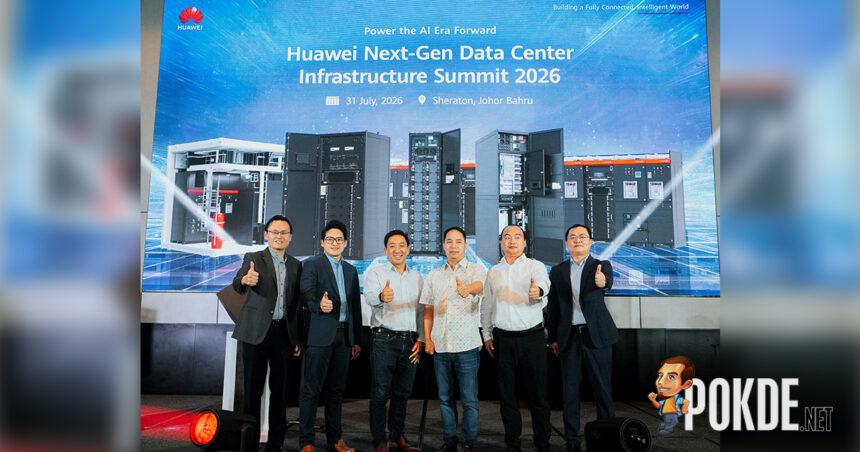
At the Huawei Next-Gen Data Center Infrastructure Summit 2026 in Johor Bahru earlier this week, Huawei Malaysia (under Huawei Digital Power) has launched four AI data center (AIDC) solutions intended to support the country’s digital infrastructure, addressing computing requirements associated with AI workloads and related applications.
The portfolio includes Huawei’s PowerPOD 5.0 integrated power system, UPS5000-H-800k intelligent power protection solution, SmartLi 5.0 intelligent energy storage solution and Thermal Management Unit (TMU) integrated cooling system. According to the company, these grid-interactive solutions combine power supply, battery energy storage and cooling technologies intended to support reliability, energy use and grid responsiveness in datacenter operations.
AI Datacenter Solutions Announced At Huawei Summit
According to Huawei, the PowerPOD 5.0 prefabricated power system reduces delivery time for datacenter power infrastructure from 60 days to two weeks, and includes AI-enabled monitoring intended to support predictive maintenance. The UPS5000-H-800k is capable of providing power continuity for critical equipment during grid fluctuations or outages, with a high-power-density design intended to support high-density AI computing.
The SmartLi 5.0 energy storage system includes a modular architecture that allows capacity expansion without interrupting operations, along with a cell-to-system protection design intended to contain faults within individual battery cells. Meanwhile, TMU cooling system provides thermal management for AI servers, incorporating automatic leak detection and predictive maintenance features intended to identify coolant-related issues.
The summit included representatives from government agencies, energy companies, datacenter developers and technology organizations, covering topics including AI datacenter development, renewable energy, high-density computing and liquid cooling. Located at the southernmost part of the Malaysia, Johor Bahru is emerging as a hub for datacenter expansion in the nation, though concerns remain on whether the rapid buildout is warranted due to concerns of high energy and water use.
Pokdepinion: While the companies are certainly incentivized to improve efficiency for datacenters, one does wonder if all this will do is create another Jevons Paradox situation.