


Product Name: Ryzen 7 7700X
Brand: AMD
Offer price: 329
Currency: USD
-
Efficiency - 8/108/10
-
Features - 7.5/107.5/10
-
Performance - 7.5/107.5/10
-
Value - 7/107/10
Summary
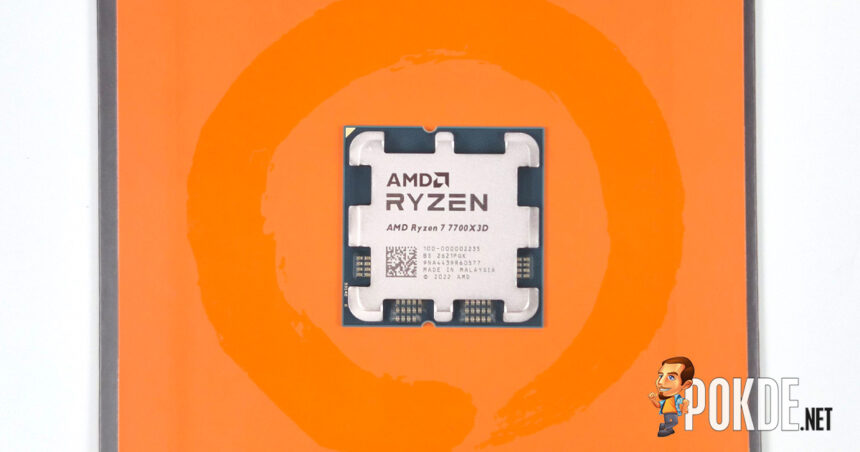
The AMD Ryzen 7 7700X3D is the cheapest option available if you want the power of 3D V-Cache on Socket AM5-based motherboards.
Overall
7.5/10Pros
+ Cheapest AM5 X3D option
+ 3D V-Cache remains a powerful add-on
+ Low power draw
Cons
– Noticeably lower single-core performance
– Value could be improved
The PC and tech industry at large is in an unusual period of time, thanks (but no thanks) to AI: rampant pricing surges, slow erosion of ownership, and a bunch of cocky multi-billionaire CEOs practically spitting in your face because you’re practically worthless in front of their newfound AI overlords. So it’s no surprise, then, the development of PC hardware has been slowed significantly to the point major chipmakers barely had anything to show for this last Computex.

Well, AMD does have something, though it’s nothing fancy. The AMD Ryzen 7 7700X3D is, if anything, more of a stopgap solution to keep its consumer sales going while the company – and the industry at large – is busy getting datacenter orders sorted while the rest of the world is fighting for breadcrumbs. Still better than nothing, we suppose?
Specifications & Comparison
AMD Ryzen 7 7700X3D vs. AMD Ryzen 7 7800X3D
Given that the Ryzen 7 7700X3D is effectively the same as the Ryzen 7 7800X3D, but slower on paper, we compare both chips in the table below and see what separates them. Click this text for the full specification sheet as published on AMD’s website.
| Processor | AMD Ryzen 7 7700X3D | AMD Ryzen 7 7800X3D |
|---|---|---|
| Core Configuration | 8 cores / 16 threads (1 CCD) | |
| Process Node | CCD: TSMC N5 IOD: TSMC N6 | |
| Microarchitecture | Zen 4 “Raphael” | |
| Boost Clock | 4.5GHz | 5.0GHz |
| Base Clock | 4.0GHz | 4.2GHz |
| Cache (L2+L3) | 8+96MB | |
| TDP Rating | 120W | |
| Max Temperature (TjMax) | 89°C | |
| Memory Support | DDR5-5200 (2-module) DDR5-3600 (4-module) Max. 128GB dual-channel ECC support (compatible motherboard required) | |
| Onboard Graphics | AMD Radeon Graphics 2 CUs (RDNA2) @ 2.2GHz | |
| Neural Processor | None | |
| Usable PCIe Lanes | 24x PCIe 5.0 | |
| Socket Type | Socket AM5 (LGA1718) | |
| Chipset Support | AMD 600, 800 series | |


As a bonus, we noticed a small packaging change on the Ryzen 7 7700X3D. On the left is the Ryzen 7 7800X3D (do note this is a sample provided by AMD so it is possible that the packaging has since changed), which featured a thick foam to fill up the packaging, while on the right is the new chip that uses a tall plastic tray instead. The branding also gets printed on the cover piece on the new model.
Test System
| CPU | > AMD Ryzen 7 7700X3D |
| Cooling | Cooler Master MasterLiquid PL360 Flux 30th Anniversary Edition Thermal Grizzly Kryonaut |
| Motherboard | ASRock B650E PG Riptide WiFi |
| GPU | NVIDIA GeForce RTX 5090 Founders Edition |
| Memory | G.Skill Trident Z5 Neo RGB DDR5-6000 CL28 (2x16GB) |
| Storage | ADATA XPG MARS 980 BLADE 1TB |
| Power Supply | Cooler Master MWE Gold 1250 V2 Full Modular (ATX12V 2.52) 1250W |
| Case | VECTOR Bench Case (Open-air chassis) |
| Operating System | Windows 11 Home 25H2 |
Benchmarks
Cinebench (Multi-Core)


Right out of the gate, we can see the reduced all-core clock speed is reflected on Cinebench results, representing 8% reduction in multi-core performance across all three Cinebench versions when compared to its closest sibling, the Ryzen 7 7800X3D. Concerningly for Team Red, the Intel Core Ultra 5 250K Plus almost doubles the performance of 7700X3D all while costing much less (its launch price is just $229, a whole $100 cheaper) – that is to say, don’t buy this if multi-core performance is what you’re looking for.
Cinebench (Single-Core)


In similar vein, the processor’s boost clock has been slashed by 500MHz when compared to the original X3D model, which is effectively a 10% reduction in theoretical single-core performance. Across three benchmark software and four tests, we’re looking at 6-13% loss in single-core (single-thread as well in the case of Cinebench 2026) scores, and that likely will convert into noticeable reduction in performance in CPU-sensitive workloads, i.e. 1080p gaming.
Power Draw & Thermals

Our sample of Ryzen 7 7700X3D seems to struggle slightly in terms of heat dissipation despite drawing noticeably less power than the Ryzen 7 7800X3D, which technically has the same “TDP” as the test subject of this review. We measured around 77W PPT in Cinebench R23, which is lower than the 88W PPT figure that 120W-class Ryzen CPUs typically adhere to, and such is the case for the 7800X3D; we suspect the low-quality binning derived from suboptimal 8-core CCD samples could be a contributing factor here (as high-quality ones would’ve gone to 7800X3D or higher models).



7-Zip

Coming back to scores, 7-Zip’s compression benchmark does not deviate from our earlier observations. Both metrics are roughly 9% slower than 7800X3D, though they remain ahead of AMD’s 6-core models, including the likes of Ryzen 5 9600X.
3DMark Time Spy

3DMark Time Spy’s CPU benchmark shows the Ryzen 7 7700X3D being, once again, slightly slower than the Ryzen 7 7800X3D, which is expected; that said, the margins are smaller than other CPU tests we’ve seen thus far, at an almost marginal 3.6% deficit.
HandBrake

The gap is even smaller in HandBrake: both Zen 4 X3D processors are merely 4 seconds off each other, representing a miniscule 1.76% slower rendering time using a 4K30 video as source. Negligible, in other words.
V-Ray 6

While the previous two workloads – which involves multi-core performance primarily – shows very little difference between the two main comparison subjects, V-Ray 6 shows a 12% difference score-wise. We shall once again point out that Intel Core Ultra 5 250K Plus obliterates AMD Ryzen 7 7700X3D for the money, once again almost doubling performance while costing $100 less.
Gaming (1080p)

We’ve established the Ryzen 7 7700X3D is on paper 10% slower than the 7800X3D on boost clocks, so how did that translate into games? Turns out, the difference is fairly significant – oftentimes the gap between the two is almost the same as when compared to Zen 5-based X3D counterparts, like the Ryzen 7 9800X3D and Ryzen 7 9850X3D. There is an exception when the game is especially GPU-heavy, as Black Myth: Wukong simply doesn’t benefit from having extra cache as GPU remains the main bottleneck of its performance.
While the 7700X3D has a very low boost clock compared to most other examples here, the 3D V-Cache still bolsters its performance enough to reliably outperform the best midrangers Intel can offer today (with one exception). As we mentioned in the Ryzen 7 9850X3D review, having extra cache also alleviates memory-related bottlenecks in cases where systems are equipped with slower memory modules, so if you can’t get your hands on a particularly fast kit, this chip can still cover such shortcomings just fine.
Verdict

It’s not exactly AMD’s first rodeo into releasing a “new” model from older CPU architectures – the chipmaker’s mobile division has done plenty of such (to the dismay of some enthusiasts decrying its confusing branding). The Ryzen 7 7700X3D is simply another example of the chipmaker extracting some additional monetary value from the discarded chiplets that couldn’t qualify to be part of 7800X3D and such, so offering it as at a decent discount is not a bad move at all.
That being said, the $329 price tag does sting. On two occasions we mentioned Intel’s current best mid-range chip, the Core Ultra 5 250K Plus, for a reason – it offers nearly the same level of gaming performance while offering significantly more multi-core performance, all while costing less on its own to largely offset the cost of buying into a dead-end platform. Besides, it seems to suffer from the same problem as the Ryzen 7 9850X3D, having its launch pricing mismatching the closely-matched model that has since have their street price sunken by a fair margin.

Ultimately we don’t expect AMD to sell a whole lot of these, for the same reason why Team Red barely produces anything less than 6 cores these days – the company (or TSMC, rather) has long mastered the art of chiplet production to the point it becomes difficult to collect enough subpar dies to spin off a new lower-end model. Price will ultimately be the deciding factor: right now, we believe 7800X3D offers better value even if it costs slightly more, but 7700X3D may eventually catch up value-wise as time goes on.

Special thanks to AMD for providing the Ryzen 7 7700X3D processor for this review.